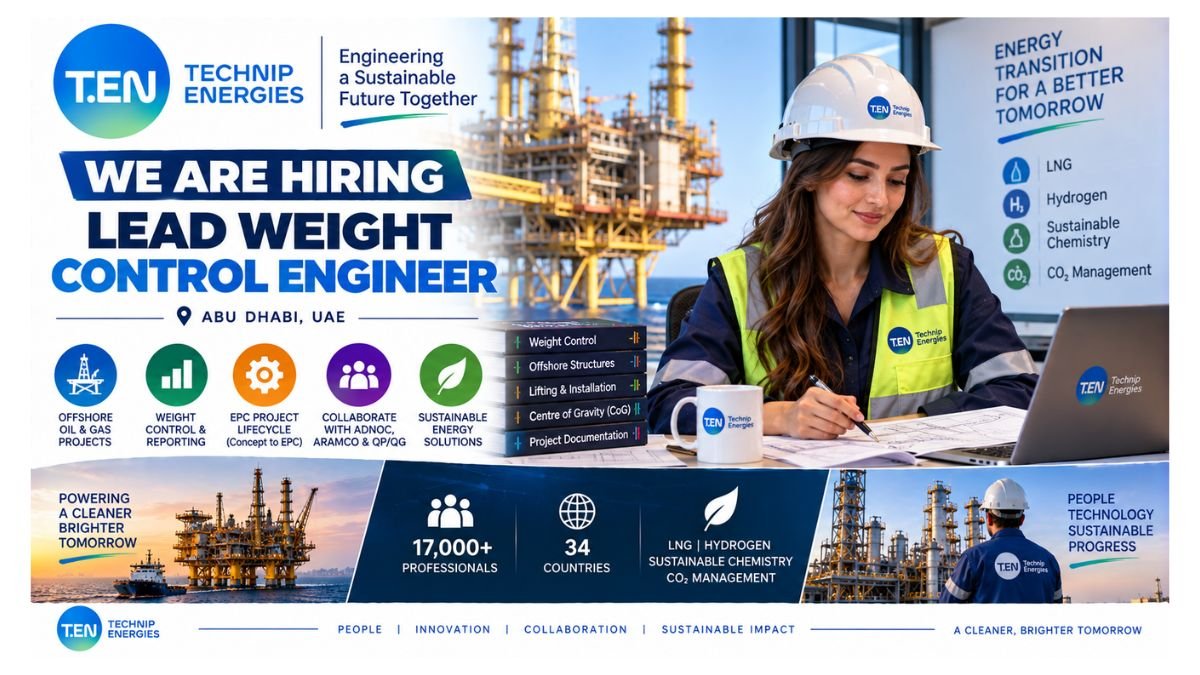
Technip Energies — a global technology and engineering powerhouse with leadership positions in LNG, hydrogen, ethylene, sustainable chemistry, and CO2 management, employing over 17,000 professionals across 34 countries — is seeking an exceptionally experienced Lead Weight Control Engineer to join its Abu Dhabi, UAE team on an immediate basis. This senior role reports directly to the Head of Department and requires a minimum of 15+ years of offshore Oil & Gas project experience and 10+ years of dedicated Weight Control reporting across all project phases from Concept through EPC — covering Fixed Offshore Platform Jacket and Topsides, weight budgets, weight growth control, Centre of Gravity (CoG) analysis, Lifting, Transportation and Installation assessments, and coordination with ADNOC, ARAMCO, and QP/QG clients. Start date is required as soon as possible.
About Technip Energies — Global Energy Technology & Engineering Leader
Company: Technip Energies — Global Technology & Engineering | 17,000+ Employees | 34 Countries | LNG · Hydrogen · Ethylene · Sustainable Chemistry · CO2 Management
Business Segments: Technology, Products & Services (TPS) and Project Delivery — turning innovation into scalable industrial reality
Abu Dhabi Operations: Active offshore Oil & Gas project portfolio including Fixed Platform Jacket & Topsides, Brownfield modifications, and offshore infrastructure for ADNOC and regional clients
Mission: Bridging prosperity with sustainability for a world designed to last — through collaboration and excellence in execution
Career Development: T. EN University · Future Ready Program · Graduate Program · Mid-Year Development Reviews · Continuous learning culture
Why This Technip Energies Lead Weight Control Engineer Role Is a Career-Defining Opportunity
Elite Offshore Engineering Brand: Technip Energies is recognized globally as one of the premier offshore oil and gas engineering organizations — the professional credibility that comes with leading weight control on a Technip Energies Abu Dhabi project is recognized and valued across the global offshore industry
Rare Specialism — High Demand: Dedicated Lead Weight Control Engineers with 15+ years of offshore experience and 10+ years of weight reporting expertise are among the most genuinely rare and most consistently sought-after specialists in the GCC offshore engineering market
ADNOC & ARAMCO Client Exposure: Direct weight control interface with ADNOC and ARAMCO — the two most commercially significant and professionally credentialing clients in the GCC offshore market — represents a career-defining professional credential
Tax-Free Abu Dhabi: Highly competitive senior offshore specialist compensation — zero personal income tax in Abu Dhabi, UAE
Position Overview
This Lead Weight Control Engineer role at Technip Energies in Abu Dhabi is a full-time, senior specialist position reporting directly to the Head of Department — responsible for developing and implementing all aspects of weight control engineering across offshore Oil & Gas projects from Concept through EPC. You will develop the Project Weight Control Procedure, Weight Breakdown Structure, and weight contingency philosophy, implement weight growth monitoring and tracking mechanisms, evaluate and define Centre of Gravity (CoG) envelopes for design-sensitive structures, assess Lifting, Transportation, and Installation CoG requirements, coordinate with all engineering disciplines for weight and CoG data collection and validation, review discipline deliverables (Structural and Piping MTOs, Vendor data, E&I layouts, HVAC layouts, Architectural drawings), review Technical Queries and Management of Change requests for weight impact, prepare Weight Control Reports, Weight Status Reports, Weight Growth Registers, and Weight Forecast Reports, coordinate with Marine Warranty Surveyors, and develop and maintain project weight databases using MS-Excel, Power BI, Navisworks, SACS, and MS Access.
Why This Technip Energies Lead Weight Control Engineer Role Is the Offshore Specialist Career of 2026 in Abu Dhabi: Lead Weight Control Engineers with 15+ years of offshore Oil & Gas experience — including 10+ years of dedicated weight control reporting across all project phases from Concept to EPC, proven Fixed Offshore Platform Jacket and Topsides weight management expertise, ADNOC and ARAMCO client interface experience, CoG analysis and Lifting/Transportation/Installation weight assessment capability, and proficiency in weight reporting software including SACS, Navisworks, Power BI, and MS-Excel — are among the most genuinely rare, most consistently in-demand, and most generously compensated offshore engineering specialists in Abu Dhabi’s extraordinarily active Oil & Gas project market in 2026.
Key Responsibilities
Weight Control Procedure, WBS & Contingency Framework
- Develop and implement the Project Weight Control Procedure — producing the master governing document that defines all weight control engineering activities, responsibilities, reporting frequencies, software tools, data sources, and quality assurance requirements across the project, establishing the procedural framework that ensures weight control is integrated effectively into all project engineering disciplines from the earliest concept stage through to EPC completion and offshore installation
- Develop the Weight Breakdown Structure (WBS) — creating the hierarchical weight accounting framework that organizes all weight data by system, subsystem, discipline, and component in a structure that supports both project management reporting needs and detailed engineering CoG analysis requirements, ensuring that weight data is consistently organized and referenced across all project phases and all discipline weight reporting inputs
- Establish the weight contingency philosophy in accordance with project phase — defining the appropriate weight contingency allowances for each project phase from Concept through FEED and EPC, reflecting the level of design development maturity, the historical weight growth patterns for similar offshore platform types, and the specific weight sensitivity requirements of the structure’s design, installation, and operating phase weight limits
- Develop and implement weight growth monitoring and tracking mechanisms — building the systematic weight growth tracking infrastructure that identifies weight growth trends early enough for design optimization interventions to remain practical, maintaining the weight growth register with current status against baseline budget and approved contingency, and producing the weight trend analyses that inform management decision-making on weight-impacting design changes
Centre of Gravity (CoG) Analysis & Marine Assessment
- Evaluate CoG for all items and define CoG envelopes for design-sensitive structures — conducting the systematic CoG analysis across all structural, piping, mechanical, electrical, instrumentation, and architectural weight items to establish accurate three-dimensional CoG positions for all major components, assemblies, and the overall platform, defining the CoG operating envelopes within which design changes must remain to satisfy stability, lifting, and installation constraints
- Assess Lifting, Transportation, and Installation CoG requirements — calculating the weight and CoG parameters required for the Marine Warranty Surveyor’s approval of Loadout, Transportation, Lifting, and Installation operations, verifying that the platform’s weight and CoG characteristics comply with the Marine Spread’s operational envelopes and the Installation Contractor’s cargo handling and lifting equipment capability limitations
- Coordinate with the Marine Warranty Surveyor (MWS) on all weight-related requirements — maintaining the technical interface with the MWS throughout the project lifecycle, providing weight and CoG data in the format and to the accuracy that the MWS requires for approval of marine operations, responding to MWS technical queries on weight methodology and data sources, and ensuring that weight control activities remain consistent with the MWS’s certification requirements
- Assess various weight limiting scenarios and define Not To Exceed (NTE) values — evaluating the weight constraints imposed by lifting equipment capacity, vessel deck capacity, topsides structural capacity, jacket leg buoyancy, installation vessel operational limitations, and regulatory weight limits to establish the NTE weight values that define the project’s hard weight constraints and must be respected throughout the design development process
Multidisciplinary Weight Data Collection & Validation
- Coordinate with all engineering disciplines to collect and validate weight and CoG data — maintaining active working relationships with Structural, Piping, Mechanical, Electrical & Instrumentation, HVAC, HSE, and Architectural engineering disciplines to ensure that weight data submissions are provided on schedule, in the correct format, and to the required level of accuracy, and that changes to discipline designs are proactively communicated for weight impact assessment before they are incorporated into the design baseline
- Review discipline deliverables to extract weight data — systematically reviewing Structural MTO lists, Piping isometric MTOs, Vendor data sheets and drawings, Electrical and Instrumentation layout drawings, HVAC layout drawings, and Architectural drawings to extract, validate, and incorporate the weight data they contain into the project weight database, identifying inconsistencies, missing information, and data quality issues that require resolution before weight reports are issued
- Review Technical Queries (TQs), Site Queries (SQs), and Management of Change (MOC) requests for weight impact — evaluating each TQ, SQ, and MOC for its weight and CoG implications, providing timely weight impact assessments that inform the approval or rejection of proposed changes, and maintaining the weight change register that documents all weight impacts approved through the project’s formal change management process
- Support weight optimization initiatives — working proactively with design disciplines to identify weight reduction opportunities that can be achieved without compromising structural integrity, operational functionality, or safety requirements, supporting the weight optimization workshop process and tracking the implementation and verification of approved weight reduction measures
Weight Reporting, Databases & Documentation
- Prepare and issue all Weight Control Reports, Weight Status Reports, Weight Growth Registers, and Weight Forecast Reports — producing the complete suite of project weight reporting deliverables at the frequencies and to the format standards required by the Project Weight Control Procedure and the client’s weight reporting requirements, ensuring that reports clearly communicate current weight status, weight growth trends, contingency consumption, forecast weight at completion, and recommended management actions
- Develop and maintain comprehensive weight databases — building and maintaining the structured weight database systems (using MS-Excel, MS Access, and applicable weight control software) that provide the accurate, current, and audit-ready repository of all weight data inputs, calculations, and reporting outputs across the project lifecycle, ensuring that weight data is consistently maintained, version controlled, and retrievable for engineering analysis, reporting, and MWS certification purposes
- Use Power BI for weight data visualization and reporting dashboards — developing Power BI dashboards that give project management, discipline engineers, and clients real-time visibility into weight status, weight growth trends, contingency consumption, and forecast completion weight in a format that supports clear, evidence-based weight management decision-making without requiring detailed review of underlying engineering weight reports
Client Interface & ADNOC / ARAMCO Coordination
- Interface with ADNOC, ARAMCO, and QP/QG clients on weight control requirements and reporting — applying familiarity with each client’s specific weight reporting practices, formats, and approval processes to ensure that Technip Energies’ weight control deliverables meet client requirements without requiring extensive revision, maintaining the professional client relationships that support productive weight control interface throughout the project lifecycle
- Coordinate with PMC, Certifying Authorities, Fabrication Contractors, Vendors, and Installation Contractors — managing the weight control technical interface with the full range of project stakeholders who require weight data for their own engineering and planning activities, ensuring that weight information flows accurately and on time to all parties who need it to discharge their own project responsibilities effectively
Qualifications & Requirements
Educational Requirements
- Bachelor’s degree in Civil/Structural Engineering or Mechanical Engineering — required, providing the engineering foundations for offshore structural weight analysis, CoG calculation, and multidisciplinary weight data validation across the full range of offshore platform disciplines
- Master’s degree in a relevant engineering discipline — not mandatory but valued, particularly for candidates whose postgraduate research focused on offshore structural engineering, marine engineering, or related technical areas
Experience Requirements
- Minimum 15+ years of experience in Offshore Oil and Gas Projects — with progressive responsibility across major offshore platform projects from Concept through EPC, demonstrating the comprehensive offshore engineering knowledge base that effective lead-level weight control requires
- Minimum 10+ years of dedicated experience in Weight Control reporting activities — specifically in weight control engineering rather than general structural or piping engineering, covering weight reporting across all design phases including Loadout, Transportation, Lifting, and Operating phases
- Proven experience in Fixed Offshore Platform Jacket and Topsides weight reporting — with demonstrated track record of managing weight budgets and weight growth control on major offshore projects from concept through EPC
- Experience in Brownfield projects, Offshore Bridges, Flare structures, and Modules — demonstrating breadth across offshore project types beyond greenfield topsides and jacket work
About Technip Energies & Offshore Weight Control Engineering in Abu Dhabi 2026
Technip Energies‘ position as a global technology and engineering powerhouse — with active project delivery capabilities spanning LNG, hydrogen, ethylene, sustainable chemistry, CO2 management, and offshore Oil & Gas infrastructure — places the company at the center of Abu Dhabi’s extraordinary energy project investment cycle. ADNOC’s ambitious offshore production expansion programs, combined with the continuing need for brownfield modification, life extension, and integrity enhancement work on the UAE’s established offshore asset base, create a sustained and technically demanding demand for senior offshore weight control engineering expertise that Technip Energies is ideally positioned to deliver. The Lead Weight Control Engineer who joins the Abu Dhabi team on this immediate-start basis will be contributing to some of the most commercially significant and technically complex offshore engineering programs in the GCC’s active energy infrastructure market — working directly with ADNOC and other major regional clients, within Technip Energies’ world-class project delivery organization, with access to T. EN University’s continuous professional development resources and the global knowledge network of 17,000+ Technip Energies engineers worldwide. For Lead Weight Control Engineers with the experience, technical depth, and ADNOC/ARAMCO client knowledge this role demands — and the readiness to join Abu Dhabi’s most active offshore engineering environment immediately — this is the career appointment that 2026 is offering.
Your Career Growth Path: Lead Weight Control Engineer → Senior Lead / Principal Weight Control Engineer → Weight Control Department Head → Chief Engineer — Weight & Naval Architecture → Director of Engineering — a globally recognized, technically elite, and commercially significant offshore engineering specialist career trajectory at one of the world’s most respected and innovative energy technology and engineering organizations.
Who Should Apply?
- Lead / Principal Weight Control Engineers (15+ Years Offshore): With 10+ years of dedicated weight control reporting on Fixed Offshore Platforms, Jacket and Topsides projects, and Brownfield modifications in the GCC who want a senior weight control role at Technip Energies in Abu Dhabi
- Senior Weight Control Engineers — ADNOC / ARAMCO Projects: With direct client interface experience delivering weight control for ADNOC, ARAMCO, or QP/QG offshore projects who want to advance to lead level within a global engineering company of Technip Energies’ caliber
- Offshore Structural Engineers — Weight Control Transition: With 15+ years of offshore structural engineering experience including substantial weight control involvement on major platform projects who want to transition into a dedicated weight control leadership role in Abu Dhabi
- Weight Control Specialists — EPC Contractors: Currently working as weight control leads at Saipem, McDermott, Subsea 7, Petrofac, or equivalent major offshore EPC contractors who want a weight control lead role within Technip Energies’ Abu Dhabi operations on ASAP basis
- Brownfield Offshore Weight Control Specialists: With specific experience in brownfield modification weight management, structure-specific NTE weight limit assessment, and Marine Warranty Surveyor coordination on live production facility projects who want to apply their specialist expertise in Technip Energies’ Abu Dhabi project portfolio

Recently Opening Job👇