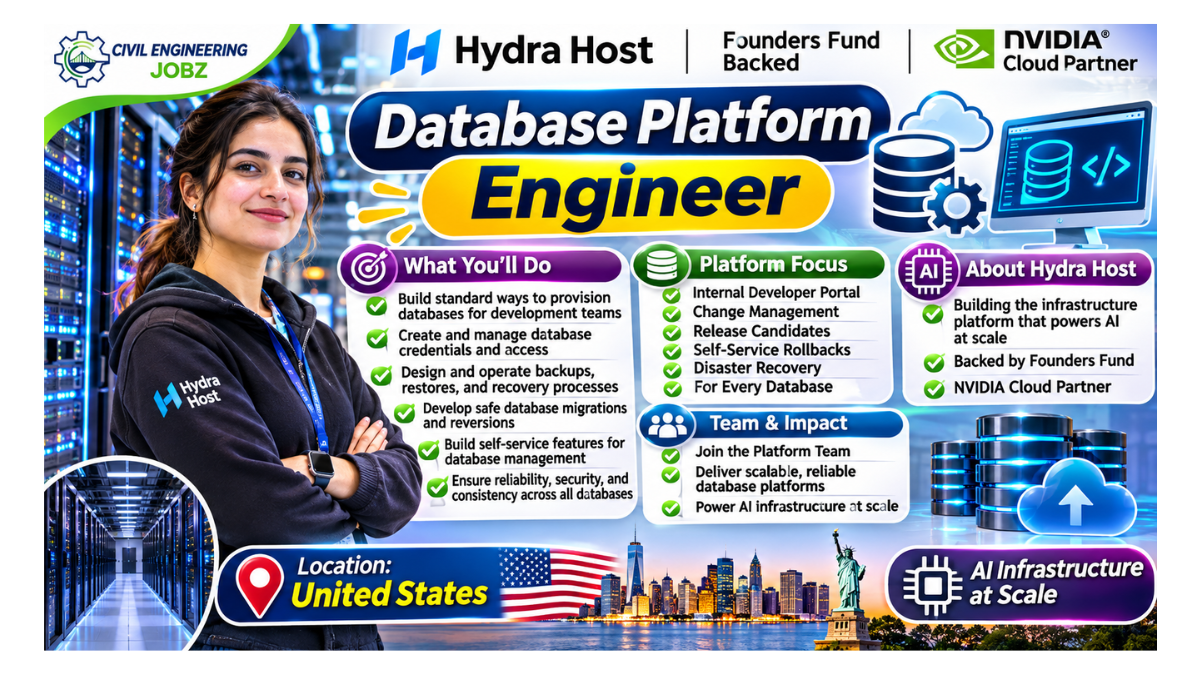
Hydra Host — a Founders Fund-backed NVIDIA Cloud Partner building the infrastructure platform that powers AI at scale — is hiring a Database Platform Engineer in the United States. Its Platform Team owns an internal developer portal covering change management, release candidates, self-service rollbacks, and disaster recovery, and the company wants one engineer to make those promises hold for every database it runs. This is a pattern-building role: you will create the standard ways dev teams provision databases, credentials, backups, restores, migrations, and reversions, and you will build the self-service features that teams use to manage them.
About This Role — Database Platform Engineer at Hydra Host
Company: Hydra Host connects AI Factories — high-performance GPU data centers — with research labs training foundation models, enterprises running production inference, and developer platforms that need compute on demand
Team: The Platform Team, which owns the internal developer portal (IDP)
Starting Point: Every database already deploys through CI/CD with backups and migrations, integrated with automated secrets and identity engines
Mission: Develop those patterns to secure, consolidate, optimize, and scale each database the company runs
Level and Type: Mid-senior level, full-time
Why This Database Platform Engineer Role Stands Out
Real Ownership: You are the subject matter expert on all things database, with a clear opinion on every architecture question
AI Infrastructure Setting: As the company scales, database management becomes central to the integrity and security of every application across its footprint
Pattern-Building Scope: You design the shared modules and self-service features other engineers rely on, rather than answering tickets
Modern Tooling: Terraform, HashiCorp Vault, OIDC identity, and Nomad or Kubernetes are all part of the daily work
Position Overview
The Database Platform Engineer owns the canonical patterns for how dev teams provision databases, credentials, backups, restores, migrations, and reversions, and builds the self-service features in the internal developer portal that teams use to manage them. You will create one shared module per database engine, consolidate databases to one server per engine with the controls that make sharing safe, decide where each database should be hosted, protect database content beyond deletion events, enforce safe change management in the shared pipeline, run backups with restore tests that prove them, and replace static passwords with short-lived, per-service credentials.
Why This Database Platform Engineer Role Stands Out: You are building the standard way an entire engineering organization works with databases, which gives your work wide and lasting impact, the posting treats rollbacks, disaster recovery, and access control as engineering problems to solve in code — not as manual runbooks, you decide the hard questions yourself, including managed versus self-hosted hosting and how to consolidate databases without losing isolation, the stack — Terraform, HashiCorp Vault, OIDC identity, and orchestrated stateful workloads — is the kind of platform engineering experience that senior employers value, and the company’s position in AI infrastructure means database reliability and security directly support customers running training and inference workloads.
Key Responsibilities
Patterns, Modules & Consolidation
- Create a single shared module per engine — Postgres, MySQL, Redis, ClickHouse, and the next engine adopted — covering provisioning, configuration, monitoring, backups, and teardown protection, invoked from the internal developer portal
- Manage and consolidate the database modules in the IaC catalog, and build more as needed
- Own the move to one server per engine, with controls that make sharing safe: per-service roles and grants in code, dynamic credentials per service, network allowlists, per-tenant restore, and an audit trail per database
- Keep database spend scaling with load, not with the number of services
- Own the decision on where each database should be hosted — managed service or self-hosted — and the reasoning behind it
Change Management & Data Protection
- Enforce forward-only, backward-compatible migrations in the shared pipeline, with migration tests on scratch databases and a schema diff on every merge request
- Gate unsafe DDL behind an explicit expand/contract acknowledgment
- Protect database content so it survives deletion events, and cover rollbacks, access, and the wider reliability and security of the data
Backup, Recovery & Access
- Run backup jobs and the restore tests that prove them, with point-in-time restore and forking available as self-service actions in the portal
- Replace static passwords with short-lived, per-service credentials from Vault
- Provide human admin access as a short-TTL escalation through the portal and Zitadel, with roles and grants in code
- Maintain an audit trail that answers who touched which database, when, and with what credential
Expertise & Self-Service Features
- Build the self-service features in the portal that dev teams use to manage their databases
- Act as the subject matter expert on databases, current on business needs and industry standards
Qualifications & Requirements
Required
- Self-starting attitude and extreme ownership — you see a gap in the platform and close it
- 5+ years running Postgres or MySQL in production: replication, failover, backup and restore, connection pooling, and healthy skepticism of a green health check
- Database lifecycle automation with Terraform, including the ability to tell from a plan when it is about to destroy data
- Experience designing forward-only, backward-compatible migration flows (Drizzle, Prisma, Alembic, Atlas, Flyway, or similar), and the ability to explain why “just run the down migration” is not a rollback strategy
- Experience with both managed platforms (Aiven, RDS, Cloud SQL, Redis Cloud) and self-hosted databases, and the ability to defend a choice between them for a given workload
- Strong HashiCorp Vault experience: the database secrets engine, policies, auth methods, and lease lifecycle
- Experience building OIDC-backed infrastructure access with Zitadel, Keycloak, Azure AD, Okta, or similar
- Comfort with stateful workloads on an orchestrator (Nomad or Kubernetes)
- Ability to read HCL, Python, TypeScript, Go, shell, and SQL
- Production database automation experience, including knowing where it breaks — migrations through a connection pooler, instances racing the same migration, lock contention, credential rotation that drops the pool, and provider quirks that turn a rename into a destroy
Preferred
- Nomad and nomad-pack, not just Kubernetes
- Zitadel, or another self-hosted OIDC provider you have run yourself
- PgBouncer or another pooler in front of automated credential rotation
- Aiven: its Terraform provider, forking, and PITR
- Restore-tested backup tooling such as restic, pgBackRest, or WAL-G
- Data infrastructure beyond OLTP: ClickHouse, Kafka, CDC/Debezium
- Experience producing compliance evidence for database access or change management (SOC 2 or similar)
About Hydra Host — Infrastructure for AI at Scale
Hydra Host is a Founders Fund-backed NVIDIA Cloud Partner building the infrastructure platform that powers AI at scale. It connects AI Factories — high-performance GPU data centers — with the teams that depend on them: research labs training foundation models, enterprises running production inference, and developer platforms that need compute capacity on demand.
Inside the company, the Platform Team owns the internal developer portal, and database management is where its promises on change management, rollbacks, and disaster recovery are either kept or broken. As the company grows, the integrity and security of every application depends on how well its databases are run.
Career Excellence: Own database platform engineering for an AI infrastructure company — where safe migrations, tested restores, and short-lived credentials turn reliability promises into something every team can count on.
Who Should Apply?
- Database Reliability Engineers: With 5+ years running Postgres or MySQL in production and real experience with failover, restores, and pooling
- Platform Engineers: Who build self-service tooling and shared modules for developer teams
- Terraform and Vault Specialists: Who automate database lifecycle and secrets safely
- Migration and Release Engineers: Who design forward-only, backward-compatible schema change flows
- Owners at Heart: Who see a gap in the platform and close it without waiting to be asked

Recently Opening Job👇