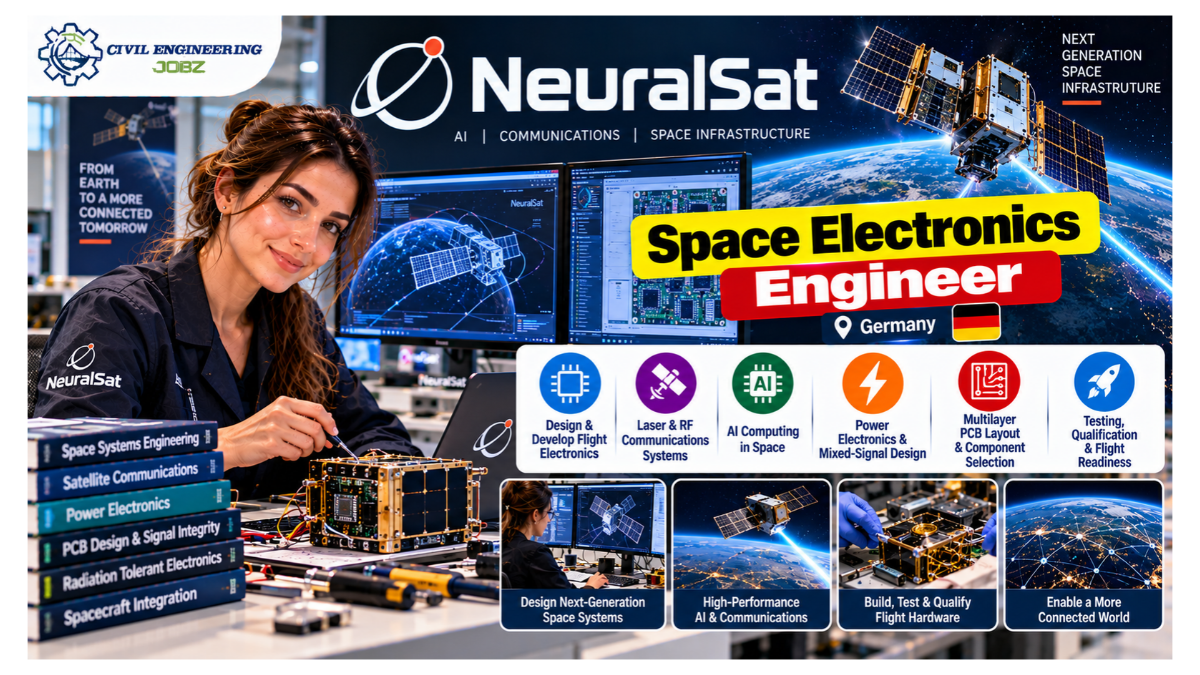
NeuralSat is building the next generation of space infrastructure — combining high-performance AI computing with laser and RF communications to deliver unprecedented capabilities in low Earth orbit. The company is now hiring a Space Electronics Engineer in Germany to design, build, test, and qualify the flight hardware that powers these groundbreaking systems. This is not a narrowly scoped embedded systems role or a single-domain RF position: it is a genuinely full-spectrum electronics engineering opportunity spanning compute architectures, communications hardware, power electronics, mixed-signal design, multilayer PCB layout, component selection for radiation tolerance, and end-to-end spacecraft integration — taking designs from initial architecture through qualification and flight readiness. As an early technical contributor at NeuralSat, you will have broad ownership and direct influence over architecture decisions, design practices, supplier selection, testing methodologies, and flight qualification outcomes — working at the exact intersection of spacecraft engineering, telecommunications, edge computing, and artificial intelligence that defines the frontier of the new space economy in 2026.
About This Space Electronics Engineer Opportunity — NeuralSat Germany
Employer: NeuralSat — a cutting-edge new space company developing space infrastructure that integrates high-performance AI computing with laser and RF communications in low Earth orbit, working at the convergence of spacecraft engineering, telecommunications, edge computing, and artificial intelligence in one of the most technically ambitious and commercially significant areas of the global technology sector in 2026
Role Focus: A uniquely broad and deeply technical Space Electronics Engineer role covering the complete hardware development lifecycle — from initial system architecture and schematic design through multilayer PCB layout, component selection for radiation tolerance, prototype bring-up, hardware debugging, subsystem characterization, and full flight qualification — across compute, communications, power, and interface domains in a mission-critical space hardware context
Technical Domains: In-orbit AI computing hardware (GPU, FPGA, AI accelerator data processing units) — laser communication terminals — Ka-band transmitters, receivers, frequency converters, amplifiers, filters, antennas, and modems — 5G NTN payload architectures aligned with 3GPP standards — digital, analog, mixed-signal, and RF-support electronics — power electronics and spacecraft power interfaces — multilayer PCB design in Altium Designer or equivalent
Location: Germany — Europe’s most important space technology nation and home to DLR (the German Aerospace Center), ESA’s ESOC and ESRIN operations, Airbus Defence and Space, OHB, and a rapidly growing ecosystem of new space startups and established aerospace primes that makes Germany the premier location in Europe for space electronics engineering talent and career development in 2026
Why This Space Electronics Engineer Role at NeuralSat Stands Out
Full Hardware Ownership from Architecture to Flight — Rare Early-Career Opportunity: Most space hardware engineering roles in Germany sit within large primes — Airbus, OHB, Thales Alenia Space — where individual engineers own narrow subsystem slices of a much larger program, with years of design review cycles before anything reaches orbit. At NeuralSat, as an early technical contributor, you own the full arc: initial architecture decisions, schematic capture, PCB layout, component selection, bring-up, debug, characterization, qualification, and flight readiness. The breadth and depth of engineering ownership available at this stage of NeuralSat’s development is genuinely uncommon — and it compresses a decade of aerospace engineering career development into the first few years of program execution.
AI Computing + Laser Communications + RF + 5G NTN — The Most Technically Advanced New Space Stack: NeuralSat is not building conventional communications satellites or standard Earth observation payloads. It is developing space infrastructure at the technical frontier: in-orbit AI computing hardware integrating GPU, FPGA, and AI accelerators; laser communication terminals capable of high-throughput optical links; Ka-band RF systems for satellite communications; and 5G NTN payload architectures aligned with 3GPP standards for non-terrestrial network integration. Working across all of these domains simultaneously develops a breadth of technical expertise — in high-speed computing, optical communications, RF engineering, and digital communications — that is genuinely rare in the aerospace sector and exceptionally valuable across the entire new space economy.
Mission-Critical Space Hardware — Design for the Harshest Environment on Earth (and Beyond): Designing electronics for spaceflight imposes constraints that have no parallel in terrestrial electronics engineering: radiation tolerance requirements that determine component selection from the earliest architecture stage; thermal management in a vacuum environment with no convective cooling; the mechanical shock and vibration of launch; the electromagnetic compatibility demands of a densely packed spacecraft; and the absolute unforgivingness of hardware that must function correctly from the moment it reaches orbit because there is no field service team 400 kilometres above the Earth. Learning to design to these constraints at NeuralSat — with real flight hardware reaching real orbit — builds the kind of rigorous, systems-thinking engineering discipline that translates into a premium career trajectory across aerospace, defence, and advanced electronics for decades.
New Space Germany — The Best Place in Europe to Build a Space Electronics Career: Germany’s space sector combines the resources of large established primes, the technical depth of DLR and the university aerospace research ecosystem, and a rapidly growing community of well-funded new space startups — making it the richest and most diverse environment in Europe for a Space Electronics Engineer who wants to develop across the full technical and commercial spectrum of the industry. NeuralSat’s location in Germany gives its engineers access to this entire ecosystem: supplier networks, academic partnerships, ESA engagement, investor community, and the talent pool of Europe’s most technically advanced aerospace nation.
Position Overview
This Space Electronics Engineer at NeuralSat Germany designs, builds, tests, and qualifies electronics for in-orbit AI computing and high-throughput communications — develops data processing units integrating GPU, FPGA, and AI accelerators — designs digital, analog, mixed-signal, RF-support, and power electronics — integrates laser communication terminals — designs Ka-band transmitter, receiver, frequency converter, amplifier, filter, antenna, and modem hardware — contributes to 5G NTN payload architectures aligned with 3GPP standards — integrates compute clusters with optical and RF communication payloads — creates schematics, multilayer PCB layouts, interface definitions, bills of materials, and manufacturing packages — selects components for performance, radiation tolerance, thermal limits, reliability, availability, and cost — and brings up, characterizes, and debugs prototype and flight hardware from initial architecture through qualification and orbit.
Why This Role Matters: The convergence of artificial intelligence and space infrastructure is not a future scenario — it is happening now, and the engineers who build the flight hardware that makes it real are writing the technical foundation of the next era of human activity in space. In-orbit AI computing changes what satellites can do: instead of transmitting raw sensor data to ground stations for processing, a satellite with genuine on-board AI computing capability can process data in real time, make decisions autonomously, execute tasks without ground station contact, and deliver processed intelligence rather than raw bandwidth. Laser communications change the economics of the entire space data chain: optical inter-satellite and satellite-to-ground links that deliver multi-gigabit throughput in a fraction of the mass and power budget of comparable RF systems. 5G NTN integration changes the reach of terrestrial connectivity infrastructure, extending mobile broadband coverage to the 95 percent of Earth’s surface that no terrestrial base station will ever serve. The Space Electronics Engineer at NeuralSat is not working on incremental improvements to existing space systems — they are building the enabling hardware for a genuinely different generation of space capability, from the schematics and PCB layouts through the component selection tables and manufacturing packages to the qualification test reports and flight readiness reviews that clear each subsystem for orbit. Every FPGA design that achieves its timing closure, every Ka-band filter that meets its passband specification, every AI accelerator integration that survives vibration testing, and every laser terminal that achieves its first optical link in orbit is a concrete, measurable step toward the space infrastructure that will define the next decade of the global space economy. That is the professional significance and daily engineering motivation of exceptional work at NeuralSat.
Key Responsibilities
In-Orbit AI Computing Hardware — GPU, FPGA & AI Accelerator Design
- Design, test, and qualify electronics for in-orbit AI computing and high-throughput communications — taking responsibility for the complete hardware development lifecycle of NeuralSat’s most technically demanding subsystems, from initial system requirements and architectural trade studies through detailed circuit design, schematic capture, PCB layout, prototype bring-up, functional characterization, environmental testing, and the full qualification test sequence that confirms flight readiness for every electronic assembly that will operate in the radiation and thermal environment of low Earth orbit — with the rigor, documentation discipline, and engineering judgment that mission-critical space hardware demands
- Develop a data processing unit integrating GPU, FPGA, and AI accelerator — architecting and implementing the high-performance computing core of NeuralSat’s in-orbit AI infrastructure, making the system-level decisions about processor selection and interconnect topology, implementing the FPGA-based interface and control fabric that manages data flows between the GPU, accelerator, memory subsystems, and communications payloads, selecting radiation-tolerant or radiation-hardened components appropriate to the mission orbit and lifetime requirements, and validating the complete DPU against its performance, power, and reliability requirements in representative thermal and radiation test environments
- Design digital, analog, mixed-signal, RF-support, and power electronics — bringing genuine multi-domain hardware expertise to the full range of electronic circuit design challenges that arise in a complex space computing and communications payload: high-speed digital interfaces (PCIe, SpaceWire, Ethernet, SerDes) operating at speeds that make signal integrity and EMC engineering as critical as functional correctness; precision analog and mixed-signal circuits for sensor interfaces, DAC/ADC integration, and timing reference generation; power electronics for the efficient, radiation-tolerant conversion, distribution, and protection of spacecraft bus power across a payload with highly dynamic and widely varying load profiles
Laser & Ka-band RF Communications Hardware — Terminal Integration & Payload Design
- Integrate laser communication terminals — working with laser communication terminal vendors and internal optical systems engineers to define the electrical interface requirements for NeuralSat’s optical communication payload, designing the electronic interface circuits that connect the laser terminal to the data processing unit and spacecraft power and data buses, supporting the mechanical and thermal integration of the terminal within the spacecraft structure, and validating end-to-end optical link performance in system-level test configurations that demonstrate the throughput, latency, and reliability targets that define NeuralSat’s competitive advantage in high-bandwidth satellite communications
- Design and integrate Ka-band transmitters, receivers, frequency converters, amplifiers, filters, antennas, and modems — applying strong RF engineering expertise to the design, procurement, integration, and characterization of the complete Ka-band communications chain, from the modem’s digital-to-RF interface through frequency conversion, high-power amplification, and antenna feed networks to the antenna aperture itself — performing link budget analysis to verify that the end-to-end RF system meets its throughput, margin, and coverage requirements across the full range of operating scenarios — and debugging RF performance issues at the component, subsystem, and system level using vector network analyzers, spectrum analyzers, signal generators, and other RF laboratory instrumentation
- Contribute to 5G NTN payload architectures aligned with 3GPP standards and integrate compute clusters with optical and RF communication payloads — bringing working familiarity with 5G physical-layer concepts and non-terrestrial network architecture principles to the design of payload hardware that supports NeuralSat’s 5G NTN connectivity objectives, ensuring that the compute and communications hardware integration enables the protocol processing, beam management, and user terminal connectivity functions that 3GPP Release 17 and subsequent NTN standards require — and working across the compute-communications interface to ensure that the AI computing capability of the data processing unit can be effectively applied to the signal processing tasks of the communications payload
PCB Design, Component Engineering, Hardware Bring-Up & Flight Qualification
- Create schematics, multilayer PCB layouts, interface definitions, bills of materials, and manufacturing packages — applying expert-level proficiency in Altium Designer or equivalent EDA tools to produce the complete set of hardware design outputs that enable reliable, repeatable manufacturing of NeuralSat’s flight electronics assemblies, with multilayer PCB stackups optimized for the signal integrity, power integrity, EMC, and thermal management requirements of high-speed computing and RF communications hardware — and with the documentation completeness and configuration control discipline that space hardware programs require from the first prototype iteration through the flight model
- Select components based on performance, radiation tolerance, thermal limits, reliability, availability, and cost — applying the multi-dimensional component engineering judgment that space hardware demands, evaluating candidate components against radiation characterization data and total ionizing dose and single-event effect requirements, thermal derating guidelines for operation across the spacecraft temperature range, reliability assessment against the component-level MTBF contributions that the system reliability budget allocates, supply chain availability and lead time constraints, and cost targets compatible with NeuralSat’s program economics — maintaining a component approved list and managing the design-in process with component vendors and distributors to ensure that flight hardware BOM availability and qualification status are continuously maintained
- Bring up, characterize, and debug prototype and flight hardware — leading the laboratory hardware bring-up process for each new electronic assembly, using a systematic, documented bring-up procedure to verify power sequencing, clock distribution, interface connectivity, and functional operation before applying full operating conditions — characterizing performance against specification across the operating voltage, temperature, and frequency range — diagnosing hardware failures with oscilloscopes, logic analyzers, VNAs, spectrum analyzers, thermal cameras, and cross-section microscopy as required — performing rework and schematic and layout corrections to resolve issues — and maintaining the detailed hardware log and fault report documentation that enables systematic design improvements across prototype iterations and into the flight build
Qualifications
Essential Requirements
- Bachelor’s or Master’s degree in electrical engineering, electronics, computer engineering, communications engineering, or a related discipline — providing the theoretical and analytical foundation for the multi-domain hardware engineering work that this role requires: circuit theory, electromagnetics, digital systems, signal processing, control theory, semiconductor physics, and the systems-level engineering thinking that connects component-level design decisions to spacecraft-level performance and reliability outcomes
- 3+ years of experience developing complex electronic hardware from concept through testing — practical engineering experience working on real hardware programs that have progressed from initial design through prototype build, bring-up, characterization, and at least integration-level testing, demonstrating the ability to produce engineering outputs of sufficient quality and completeness that hardware can actually be built, brought up, and tested — not just designed on screen
- Strong expertise in high-speed digital computing hardware, RF communications, or optical communications — recognized depth of competency in at least one of the three major technical domains that define NeuralSat’s hardware stack, combined with the working knowledge in the others that comes from genuine breadth of engineering curiosity and multi-domain problem-solving experience
- Understanding of laser communications, RF systems, satellite link budgets, and digital communications — sufficient working knowledge of optical and RF communications theory and satellite link analysis to contribute meaningfully to payload architecture trade studies, interface requirement definition, and system-level performance characterization, without requiring senior colleagues to translate every communications engineering concept into language accessible to a pure digital engineer
- Familiarity with cellular systems and 5G physical-layer concepts — sufficient 5G NTN technical awareness to engage productively with 3GPP standard documents, contribute to payload architecture decisions that affect NTN compliance, and understand the physical-layer implications of non-terrestrial network integration on spacecraft hardware design
- Experience with schematic capture and multilayer PCB design using Altium Designer, KiCad, or equivalent — practical EDA tool proficiency demonstrated through actual PCB designs that have been fabricated and assembled, with knowledge of multilayer stackup design, signal integrity constraint application, design rule checking, and manufacturing package generation at a level that produces buildable, testable PCBs without requiring extensive layout revision after design review
- Practical experience with board bring-up, debugging, rework, and laboratory instrumentation — hands-on laboratory skills demonstrated through real bring-up and debug work on complex electronic assemblies, including the use of oscilloscopes, logic analyzers, vector network analyzers, spectrum analyzers, power supplies, and the judgment to know which instrument and which measurement approach will most efficiently diagnose any given hardware failure mode
Germany — Europe’s Space Engineering Capital
Germany is home to DLR — the German Aerospace Center — one of the world’s leading space research organizations, with major facilities in Cologne, Munich, Berlin, and Bremen. It is the location of ESA’s ESOC mission control center in Darmstadt and the birthplace of modern rocket technology. Airbus Defence and Space, OHB, MT Aerospace, and dozens of tier-2 and tier-3 aerospace suppliers constitute a supply chain infrastructure for space hardware manufacturing that has no peer in continental Europe. And Germany’s new space ecosystem — Isar Aerospace, HyImpulse, Mynaric, Proxima Fusion, NeuralSat — is growing rapidly, supported by DLR’s new space program, ESA BIC Germany, and a well-developed venture capital infrastructure that has directed hundreds of millions of euros into German space technology startups in recent years. For a Space Electronics Engineer looking to build a career at the frontier of the global space industry, Germany in 2026 offers unmatched access to technical peers, supply chain partners, research collaborators, and career development opportunities across the full spectrum of the space sector.
Career Excellence: FPGA Design, GPU AI Accelerator Integration, Ka-band RF Systems, Laser Communication Terminals, Multilayer PCB Altium Designer, 5G NTN 3GPP Payload Architecture, Mixed-Signal Electronics, Power Electronics, Radiation-Tolerant Component Selection, Flight Hardware Qualification, Board Bring-Up and Debug, Spacecraft System Integration, Satellite Link Budget Analysis — Space Electronics Engineer, NeuralSat, Germany 2026.
Who Should Apply?
- Space Hardware Engineers — FPGA / GPU / AI Computing Germany 2026: Electronics engineers with 3+ years of FPGA design, GPU integration, or high-speed computing hardware experience — ready to apply those skills to the design and qualification of in-orbit AI computing hardware at a new space company in Germany with full technical ownership from architecture to flight
- RF Engineers — Ka-band Satellite Communications Germany 2026: RF hardware engineers with Ka-band transmit/receive chain, frequency conversion, or satellite communications system experience — looking for a role at the intersection of satellite RF, optical communications, and in-orbit AI computing at a German new space company building genuinely frontier space infrastructure
- PCB Design Engineers — Space Grade Multilayer Altium Germany 2026: Experienced multilayer PCB designers with Altium Designer proficiency and hardware bring-up experience — ready to work on space-grade flight electronics designs that combine high-speed digital computing, RF-support circuitry, and mixed-signal analog design in a single mission-critical assembly
- Laser / Optical Communications Hardware Engineers — New Space Germany: Engineers with laser communication terminal integration, optical systems hardware, or high-bandwidth optical link experience — who want to combine their optical expertise with Ka-band RF and AI computing integration work at a new space company developing next-generation high-throughput satellite communications in Germany
- Space Electronics Engineers — 5G NTN Payload Architecture Germany 2026: Electronics engineers with satellite hardware, telecommunications payload, or 5G physical-layer experience — seeking a full-ownership Space Electronics Engineer role in Germany that spans in-orbit AI computing, laser communications, Ka-band RF, 5G NTN payload architecture, multilayer PCB design, radiation-tolerant component selection, prototype bring-up, and flight qualification at one of Germany’s most technically ambitious new space companies

Recently Opening Job👇