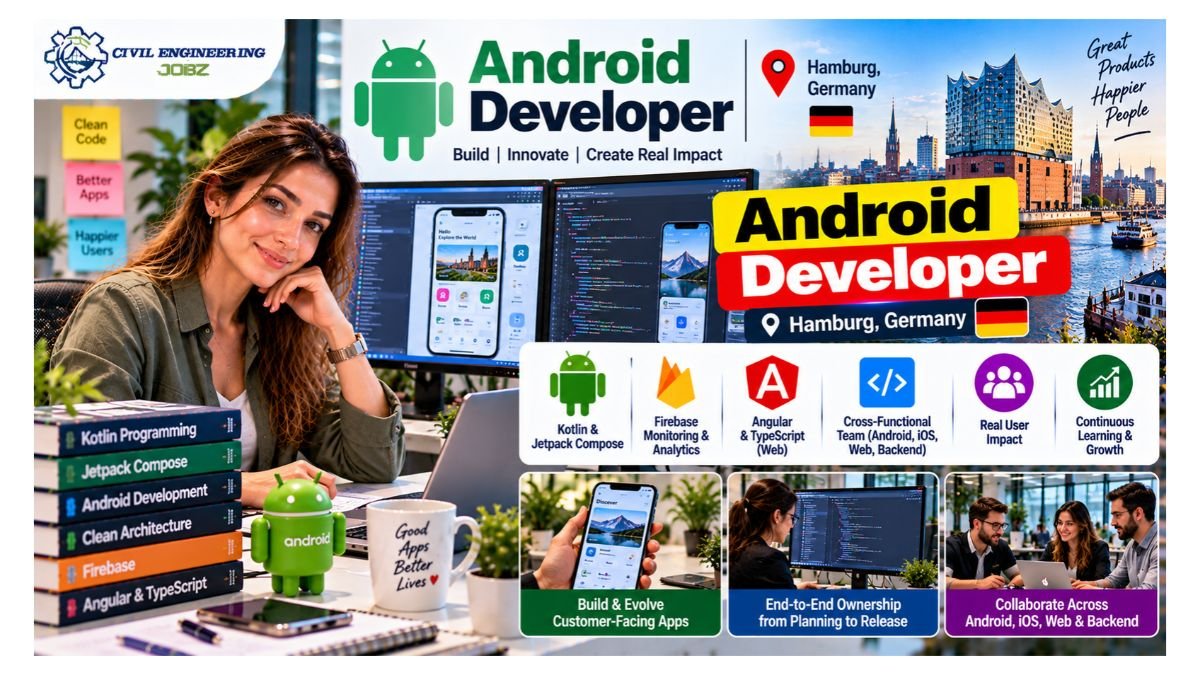
A growing digital product team in Hamburg, Germany is hiring an Android Developer to build and evolve customer-facing mobile applications used by a large, real-world audience. You will develop modern Android features using Kotlin and Jetpack Compose, deliver accessible and high-quality applications that customers genuinely rely on, and take end-to-end ownership of the Android development lifecycle — from planning and implementation through testing, release, and ongoing performance monitoring with Firebase. Working within a cross-functional domain team that spans Android, iOS, web, and backend engineering, you will shape seamless and consistent customer experiences across all platforms — and have the opportunity to contribute to web development using Angular and TypeScript when the product calls for it. This is an outstanding Android Developer opportunity in one of Germany’s most vibrant and technically active tech hubs, offering genuine platform ownership, cross-discipline collaboration, and continuous professional growth in a team that values shared knowledge, high engineering standards, and a real culture of continuous improvement.
About This Android Developer Opportunity — Hamburg, Germany
Team: A growing digital product team in Hamburg building and evolving customer-facing mobile and web applications used at genuine scale — where the Android Developer plays a key role in shaping the mobile experience, working within a cross-functional domain team that takes end-to-end ownership of the customer experience across Android, iOS, and web, and contributes to product-level technical decisions rather than just implementing tickets
Role Focus: Primary ownership of Android development — building and maintaining high-quality, accessible, scalable Android applications in Kotlin with Jetpack Compose, managing the full Android release lifecycle, monitoring app performance with Firebase, and collaborating with engineers across iOS, web, and backend to deliver cohesive, platform-agnostic customer experiences — with the opportunity and expectation to contribute to web development in Angular and TypeScript when the product domain calls for it
Technical Depth: Modern Android development at genuine engineering depth — Clean Architecture and MVVM design patterns, Jetpack Compose declarative UI, comprehensive test coverage (unit, integration, and UI tests), REST API integration, CI/CD with GitHub Actions, accessibility-conscious layout and UX implementation, and the engineering practices that produce applications that are reliable and maintainable at scale, not just functionally complete at launch
Location: Hamburg, Germany — one of Germany’s most dynamic, internationally connected, and professionally desirable tech cities, with a thriving digital product and mobile development ecosystem, excellent quality of life, and a strong concentration of well-funded product companies, digital agencies, and scale-up technology teams across e-commerce, media, logistics, fintech, and consumer applications
Why This Android Developer Role in Hamburg Stands Out
Real Customer Impact at Scale — Large Audience, Production Android Applications: Android development at scale — on applications that real customers use daily, where performance regressions, accessibility failures, and reliability issues have immediate, measurable impact on user experience and business outcomes — is fundamentally more demanding and professionally more rewarding than Android work on internal tools, proof-of-concept applications, or early-stage products with small user bases. This role involves building and evolving applications that a large audience depends on, which means every architecture decision, every Compose performance optimization, every test you write, and every release you manage has real consequences for real people. That accountability is the foundation of serious Android engineering growth.
Jetpack Compose + Modern Android Stack — The Career-Critical Technology Transition: The Android development community is in the middle of the most significant platform transition in its history — from XML-based View layouts to Jetpack Compose’s declarative UI paradigm — and developers who have genuine, production-proven Compose experience are the most in-demand Android engineers in the German and global job market. Working with Jetpack Compose on customer-facing applications in a cross-functional team that applies Clean Architecture and MVVM rigorously is the highest-value Android engineering environment available for a developer who wants to be at the leading edge of the platform in 2026 and beyond.
Cross-Functional Domain Ownership — Android, iOS, Web, Backend in One Team: Being embedded in a cross-functional domain team that owns the customer experience across Android, iOS, and web is materially different from working in a platform-siloed mobile team where Android developers only ever interact with other Android developers. Cross-functional ownership develops the product thinking, cross-platform UX empathy, API design perspective, and systems-level engineering judgment that distinguish Senior Android Engineers who can lead product domains from Android developers who can only execute feature tickets within a single platform. And the explicit opportunity to contribute to Angular and TypeScript web development makes the cross-discipline breadth even more professionally valuable.
Hamburg Tech Ecosystem — Germany’s Second-Largest Tech Hub: Hamburg has grown into Germany’s second-largest technology hub — home to companies including XING, About You, Statista, Fahrbar, Kühne + Nagel, and a dense ecosystem of digital product companies, agencies, and tech scale-ups across e-commerce, media, fintech, and logistics that collectively create one of the deepest and most diverse mobile and web engineering talent communities in Germany. The Android developer job market in Hamburg is active, well-compensated, and offers the kind of career variety and professional networking depth that only a major city tech ecosystem can provide.
Position Overview
This Android Developer in Hamburg develops and maintains high-quality, reliable, scalable, and accessible Android applications for a large customer audience — takes end-to-end ownership of the Android development lifecycle from planning and implementation through testing, release, and performance monitoring — collaborates with engineers across Android, iOS, web, and backend to deliver cohesive cross-platform customer experiences — contributes to web applications built with Angular and TypeScript — shapes technical solutions at product and domain level — manages app releases and monitors performance with Firebase — stays current with Android ecosystem developments and introduces relevant technologies and practices — and supports the wider team through code reviews, technical guidance, pair programming, and knowledge sharing within a culture of collaboration, shared ownership, and continuous improvement.
Why This Role Matters: The Android applications that this team builds are not side features or internal tooling — they are the primary way a large audience of real customers engages with the product on their most personal device. A smartphone is something people carry everywhere, unlock dozens of times a day, and use for tasks that genuinely matter to their daily lives: shopping, scheduling, communicating, managing services, staying informed. When the Android application is fast, reliable, accessible, and thoughtfully designed — when Jetpack Compose UI reacts fluidly to user input, when background tasks complete reliably without draining the battery, when accessibility features work correctly for users who depend on them, when the release process is smooth enough that new features reach customers quickly and bug fixes arrive before user frustration compounds — the product delivers genuine value in the moments that matter to customers. And when the Android Developer who owns these outcomes works within a cross-functional team with full domain ownership, their architectural decisions don’t just affect the Android codebase — they shape the shared understanding of how the product should work across all platforms, influence API design conversations with backend engineers, inform iOS architecture discussions, and contribute to the kind of consistent, platform-agnostic customer experience that distinguishes genuinely excellent digital products from collections of inconsistently maintained platform-specific apps. That is the professional significance and daily engineering motivation of excellent Android development in this role.
Key Responsibilities
Android Application Development — Kotlin, Jetpack Compose & Full Lifecycle Ownership
- Develop and maintain high-quality Android applications that are reliable, scalable, efficient, and accessible — writing production Kotlin code that applies Android best practices, Jetpack library APIs, and the Clean Architecture and MVVM design patterns that keep the codebase maintainable as the product grows — implementing Jetpack Compose UIs that are performant, accessible, and consistent with the design system — and taking the kind of long-term ownership of code quality, architectural integrity, and technical debt management that prevents the accumulation of maintenance burden that eventually slows every fast-moving digital product team down
- Take ownership of the Android development lifecycle — from planning feature requirements and breaking them into well-scoped implementation tasks, through writing the implementation and its accompanying tests, preparing the release with appropriate version management and release notes, managing the Google Play Store release process, monitoring post-release performance and crash rates in Firebase, and responding promptly to any reliability or performance regressions that post-release monitoring identifies — treating the full release lifecycle as a professional responsibility, not just the coding phase, and maintaining the monitoring discipline that keeps a large-audience application operating at the reliability standards that customers have the right to expect
- Stay current with developments in the Android ecosystem and introduce relevant technologies, tools, and engineering practices to the team — tracking Google I/O announcements, Jetpack library releases, Kotlin language evolution, and Android platform changes that affect application development; evaluating new tools and practices against the team’s actual engineering challenges; and proposing and advocating for the technology updates that will genuinely improve application quality, development efficiency, and engineering team capability — while filtering out the hype-driven technology changes that consume adoption effort without delivering proportionate value
Cross-Platform Collaboration — iOS, Web, Backend & Domain-Level Product Engineering
- Collaborate with engineers across Android, iOS, web, and backend development to deliver cohesive customer experiences — participating in cross-platform technical discussions with the perspective of an Android specialist who genuinely understands the product domain and the customer experience across all platforms, contributing to API design conversations with backend engineers with the Android client’s usage patterns and performance requirements in mind, aligning with iOS colleagues on cross-platform UX consistency decisions, and maintaining the communication and documentation practices that keep a cross-functional team genuinely aligned across multiple codebases and technology stacks
- Contribute to web development using Angular and TypeScript when the product domain requires it — approaching web contribution with genuine curiosity and the learning mindset that allows a strong Android developer to become a productive Angular contributor within a reasonable ramp-up period, applying the software architecture principles (component thinking, separation of concerns, testable design) and engineering practices (code review discipline, testing coverage, performance awareness) that transfer directly from Android development to TypeScript-based web development, and treating cross-discipline web contribution as a genuine professional development opportunity rather than an unwelcome distraction from primary Android work
- Help shape technical solutions at a product and domain level — contributing to feature planning, technical design, and architecture discussions with the full-stack product context that comes from working in a cross-functional domain team with end-to-end customer experience ownership, prioritizing the overall customer experience over any single platform’s convenience, and bringing the user-facing impact perspective — latency, accessibility, reliability, battery consumption — that makes Android engineers’ contributions to product-level technical decisions distinctively valuable in cross-functional teams where backend and web engineers may lack direct experience of mobile-specific engineering constraints
Engineering Culture — Testing, Code Review, Knowledge Sharing & Continuous Improvement
- Write maintainable, testable code with comprehensive test coverage — including unit tests for business logic and data layer components, integration tests for API and repository interactions, and UI tests for Compose screens and user flows — with the test design discipline that produces tests that are fast, reliable, meaningful, and maintainable rather than slow, flaky, trivial, or so tightly coupled to implementation details that they break on every refactoring; applying testing as a tool for confident, sustainable delivery velocity rather than as a compliance box to tick before pushing code for review
- Support the wider team through code reviews, technical guidance, and pair programming — conducting code reviews that provide specific, actionable, constructive feedback on correctness, maintainability, performance, accessibility, and alignment with team architecture standards — pair programming with colleagues on technically challenging implementations or knowledge transfer objectives — and sharing technical knowledge through informal discussions, team documentation, and the collaborative problem-solving approach that builds team capability rather than individual heroism, making the team as a whole more effective rather than making individuals more indispensable
- Contribute actively to a culture of collaboration, shared ownership, and continuous improvement — learning from colleagues across Android, iOS, web, and backend disciplines with genuine intellectual curiosity, contributing the Android and mobile perspective to cross-discipline engineering and product discussions, proposing process improvements to development workflows, testing practices, release procedures, and code quality standards, and embodying the collaborative professional culture that makes high-performing cross-functional product teams genuinely enjoyable and sustainable to work in over the long term — where every team member’s growth is supported by the team, and every individual’s contribution makes the entire team stronger
Qualifications
Essential Requirements
- At least three years of hands-on Android development experience using Kotlin, the Android SDK, and established Jetpack libraries — demonstrated through production application development rather than tutorial projects or prototype work, with the practical engineering depth that comes from having worked through the full development lifecycle on real applications: initial architecture, feature implementation, code review, testing, release management, and post-release maintenance in a production environment
- Practical experience with Jetpack Compose and modern Android development practices — production-proven experience implementing Compose-based UIs in real applications, with working knowledge of composable lifecycle, state management (remember, mutableStateOf, StateFlow), side effects (LaunchedEffect, DisposableEffect), recomposition performance optimization, Compose theming and Material Design 3 integration, and the Compose Navigation library for multi-screen Android applications
- Strong understanding of software architecture and design patterns — specifically Clean Architecture’s layered separation of concerns and MVVM’s ViewModel-driven UI state management, demonstrated through application designs that are actually structured this way rather than just referenced in conversation, with the dependency injection (Hilt), repository pattern, and use case implementations that make the architecture genuinely testable and maintainable in a multi-developer codebase
- Experience writing maintainable, testable code — including unit tests for business logic and domain layer components, integration tests for repository and API interaction, and UI tests for Compose screens and critical user flows — with the test quality discipline that produces a test suite that provides genuine confidence rather than a false sense of coverage
- Confidence working with REST APIs, JSON, and web service integrations — practical experience integrating Android applications with HTTP REST APIs using Retrofit or equivalent libraries, handling JSON serialization and deserialization, managing API error states, implementing appropriate network caching strategies, and applying the coroutines-based asynchronous network programming patterns that modern Android applications depend on
- Familiarity with modern development workflows and CI/CD tools such as GitHub Actions — experience working within automated build, test, and release pipelines that enforce code quality standards and enable frequent, confident releases without manual overhead, with the Git branching workflow discipline (feature branches, pull requests, branch protection) that keeps a multi-developer Android codebase clean and navigable
- Curiosity about technologies beyond Android — specifically a genuine interest in contributing to web development using TypeScript and Angular, with either existing web development experience (a meaningful advantage) or a credible and sincere willingness to develop Angular proficiency as part of the cross-functional team role; and the intellectual openness to learn from iOS and backend colleagues and apply cross-platform engineering thinking to product-level technical decisions
Why Hamburg — Germany’s Digital Product Capital
Hamburg is Germany’s second-largest city and, by many measures, its most vibrant digital product and consumer technology hub — home to XING (now NEW WORK SE), About You, Statista, Fahrbar, and a dense ecosystem of e-commerce, media, fintech, and consumer application companies that collectively employ thousands of mobile and web engineers in one of Europe’s most active and well-compensated tech labor markets. Hamburg’s Android developer community is particularly active — with regular meetups, conferences, and the kind of informal professional network that comes from a city where enough people are doing the same interesting work to make chance encounters at coffee shops and co-working spaces genuinely generative. Hamburg also offers a quality of life that no other German tech city quite matches: a working port that gives the city a cosmopolitan, outward-looking energy; a food and culture scene that reflects its historic status as one of northern Europe’s great trading cities; excellent public transport; and the combination of genuine urban vitality and surprisingly good access to nature — the Alster lakes, the Elbe riverbanks, and the North Sea coast within an hour’s drive — that makes Hamburg one of the most balanced and enjoyable cities in Germany to build a career and a life simultaneously.
Career Excellence: Kotlin, Jetpack Compose, Android SDK, Jetpack Libraries, MVVM Architecture, Clean Architecture, Firebase Performance and Crashlytics, REST API and JSON Integration, GitHub Actions CI/CD, Unit and Integration and UI Testing, Angular and TypeScript Web Development, Cross-Platform Team Collaboration, App Release Management, Code Review and Pair Programming — Android Developer, Hamburg, Germany 2026.
Who Should Apply?
- Android Developers — Kotlin Jetpack Compose Hamburg Germany 2026: Android developers with 3+ years of Kotlin and Jetpack Compose experience — ready to join a growing digital product team in Hamburg for a permanent role with large-audience customer-facing application ownership, cross-functional collaboration, and a genuine culture of engineering excellence and continuous improvement
- Mobile App Developers — MVVM Clean Architecture Android Hamburg 2026: Android engineers with strong MVVM and Clean Architecture experience — who want to bring that architectural discipline to customer-facing applications used at meaningful scale in a cross-functional team with end-to-end domain ownership spanning Android, iOS, web, and backend
- Android Developers Seeking Cross-Platform Experience — Angular TypeScript Hamburg: Android developers who want to broaden their technical profile with Angular and TypeScript web development contributions alongside their primary Android focus — in a Hamburg product team that genuinely supports and encourages cross-discipline contribution rather than confining Android engineers to a single-platform silo
- Firebase Android Developer — Hamburg Germany CI/CD GitHub Actions 2026: Android developers with Firebase performance monitoring and crash analytics experience — combined with CI/CD discipline using GitHub Actions — who want to apply that full-lifecycle release ownership expertise in a customer-facing product team that takes post-release monitoring as seriously as pre-release testing
- Android Developer Hamburg Germany 2026 — Jetpack Compose Firebase REST API: Seeking an Android Developer role in Hamburg, Germany — where Kotlin, Jetpack Compose, Android SDK, MVVM, Clean Architecture, Firebase, REST API integration, unit and UI testing, GitHub Actions CI/CD, Angular web contribution, cross-platform collaboration, code review, pair programming, and continuous engineering improvement combine in a growing digital product team building customer-facing applications for a large audience with genuine engineering ownership and a collaborative, knowledge-sharing team culture in one of Germany’s most vibrant technology cities

Recently Opening Job👇
Frontend Developer Jobs Frankfurt Hesse Germany 2026