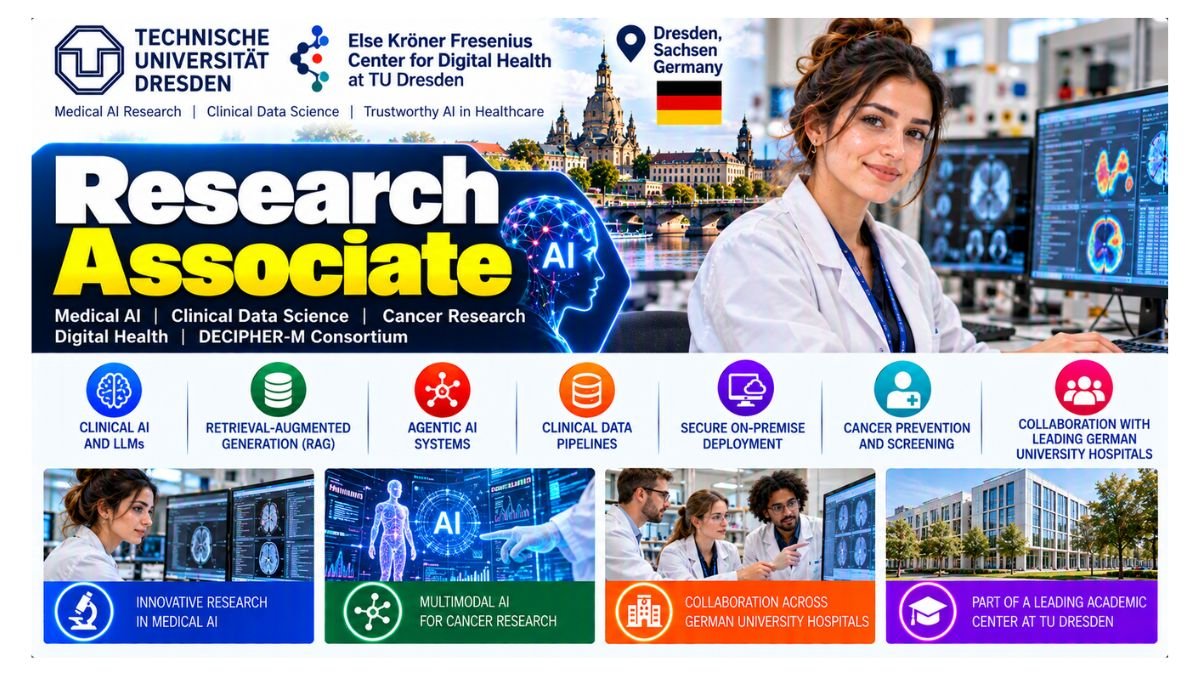
The Else Kröner Fresenius Center for Digital Health at TU Dresden — one of Germany’s leading academic centers for medical AI research, clinical data science, and trustworthy AI in healthcare — is hiring a Research Associate (m/f/d) within the federally funded DECIPHER-M consortium (Deciphering Metastasis with Multimodal Artificial Intelligence Foundation Models). This is a rare opportunity to work at the technical frontier of clinical AI, Large Language Models (LLMs), retrieval-augmented generation (RAG), agentic AI systems, and secure on-premise clinical data deployment — building the data pipelines, AI interfaces, software architectures, and agent-based workflows that will power a next-generation AI system for personalized cancer prevention and screening recommendations across major German university hospitals. The position is available immediately, offered full-time or part-time, initially for 24 months with strong extension potential and longer-term collaboration, remunerated at TV-L pay group E13, and supervised by Prof. Carolin Schneider (W3 Chair for Digital Preventive Medicine). DECIPHER-M is funded by the Federal Ministry for Research, Technology and Space (BMFTR) and spans the university hospitals of Dresden, Aachen, Essen, Munich, Mainz, the German Cancer Research Center, and Helmholtz AI.
About This Research Associate Opportunity — TU Dresden DECIPHER-M Dresden Saxony
Institution: TU Dresden — Else Kröner Fresenius Center for Digital Health — a leading German academic research center dedicated to developing, validating, and clinically integrating AI-powered tools that improve healthcare outcomes, operating at the interface of computer science, medicine, and data science in Dresden, Saxony
Project: DECIPHER-M (Deciphering Metastasis with Multimodal Artificial Intelligence Foundation Models) — a BMFTR-funded national research consortium combining clinical and technical AI expertise across Dresden, Aachen, Essen, Munich, Mainz, the German Cancer Research Center, and Helmholtz AI — focused on developing a modular AI prevention agent for personalized cancer prevention and screening recommendations
Technical Focus: This position is at the core of the DECIPHER-M technical architecture — responsible for integrating clinical data sources with LLM and agent systems, building high-performance clinical data pipelines, developing APIs and software components for secure clinical AI deployment, and implementing on-premise LLM deployments with data protection, traceability, and clinical usability at their center
Contract & Salary: Fixed-term 24 months with extension option and long-term collaboration potential — full-time or part-time — TV-L pay group E13 with annual bonus — available as soon as possible
Why This Research Associate Role at TU Dresden Stands Out
Work at the Frontier of Clinical AI & LLM Research in Germany: DECIPHER-M is one of the most technically ambitious federally funded medical AI projects in Germany right now — developing multimodal AI foundation models for cancer prevention that combine clinical data, genomics, imaging, and natural language — a project where your LLM engineering and clinical data pipeline work will have direct and measurable impact on future cancer screening practice in Germany
LLM + RAG + Agentic AI in a Real Clinical Setting: This is not a theoretical LLM research role. You will be building the actual data interfaces, agent workflows, knowledge base integrations, and on-premise deployment infrastructure that allow LLM-powered AI agents to generate personalized, guideline-compliant cancer prevention and screening recommendations for real patients in real clinical workflows — one of the most technically demanding and socially meaningful applications of LLM technology currently underway in German academia
Interdisciplinary Consortium — National-Scale Research Impact: Working within DECIPHER-M gives you access to a national network spanning seven of Germany’s top university hospitals and research centers, connecting clinical oncologists, AI researchers, genomics experts, and health policy specialists — building professional relationships, co-authoring publications, and developing a research profile that spans the full breadth of modern medical AI
TV-L E13 — Transparent, Competitive Academic Salary with Full Benefits: TV-L E13 is the standard pay grade for qualified research associates at German public universities — offering transparent salary progression, 30 days holiday, job ticket subsidy, health and sports programs, family office support, and employee discounts — at one of Germany’s most vibrant, affordable, and culturally rich university cities
Position Overview
This Research Associate (m/f/d) at the Else Kröner Fresenius Center for Digital Health, TU Dresden develops and implements the technical infrastructure for the DECIPHER-M AI prevention agent — builds clinical data interfaces and high-performance pipelines for structured and unstructured health data — co-develops LLM agent architectures — integrates RAG systems, knowledge bases, and medical guideline modules — develops secure on-premise AI deployment solutions — creates APIs and software components for clinical systems integration — builds user interfaces and demonstrators for clinical workflows — and systematically evaluates AI components for technical robustness, medical plausibility, provenance, and clinical applicability — all in close collaboration with clinical and technical partners across the DECIPHER-M consortium spanning Dresden, Aachen, Essen, Munich, Mainz, the German Cancer Research Center, and Helmholtz AI.
Why This Role Matters: Cancer is Germany’s second leading cause of death, and the gap between what evidence-based prevention guidelines recommend and what patients actually receive in clinical practice remains stubbornly wide — not because clinicians do not care, but because translating complex, multi-factor, constantly evolving clinical guidelines into practical, personalized, patient-specific recommendations within the time constraints of a real clinical consultation is genuinely hard. The AI prevention agent that DECIPHER-M is building — and that this Research Associate role will be essential to technically realizing — is designed to close that gap. When the data pipeline you build correctly loads and structures a patient’s clinical history from a hospital information system into an LLM agent that can reason over it, the RAG system you implement retrieves the most current and applicable cancer prevention guideline recommendation for that specific patient profile, the on-premise deployment architecture you design ensures that sensitive patient data never leaves the hospital’s own infrastructure, and the API layer you develop allows the clinical decision support output to appear directly within the physician’s existing workflow without any additional clicks or system switches — you are not writing software. You are building the technical infrastructure that will help German clinicians give their patients better, more personalized, more guideline-consistent cancer prevention advice at scale. That is the real-world impact of excellent clinical AI engineering, and that is what this role exists to deliver.
Key Responsibilities
Clinical Data Integration, Pipelines & LLM Agent Architecture
- Develop and implement interfaces between clinical data sources, medical knowledge bases, and local LLM and agent systems — designing and building the technical integration layer that connects hospital information systems, EHR platforms, genomic data sources, and medical knowledge repositories with the DECIPHER-M AI prevention agent’s LLM and reasoning components in a secure, auditable, and clinically reliable manner
- Build high-performance data pipelines for loading, structuring, validating, and further processing interoperable health data — developing robust ETL and data transformation workflows that handle the heterogeneous, sensitive, and often incomplete nature of real clinical data while maintaining the data quality, traceability, and interoperability standards that medical AI applications require
- Co-develop the technical architecture of LLM agents within the DECIPHER-M system — contributing to the design of the agentic AI framework that coordinates LLM inference, knowledge retrieval, clinical reasoning, guideline lookup, and recommendation generation within the prevention agent’s modular architecture, with particular attention to latency, reliability, and clinical usability
RAG Systems, Knowledge Bases & Clinical Guideline Integration
- Integrate structured and unstructured clinical information into agent-based workflows for personalized cancer prevention and screening recommendations — developing the data processing and semantic enrichment pipelines that transform raw clinical records, lab results, imaging reports, and patient histories into structured, LLM-processable inputs that enable the prevention agent to generate accurate, personalized, and guideline-aligned recommendations
- Develop APIs, data models, and software components for secure communication between clinical systems, AI modules, and user interfaces — designing and implementing the API layer that enables the DECIPHER-M prevention agent to communicate with hospital clinical systems, receive patient data, return recommendations, and log interactions in a GDPR-compliant, auditable, and interoperable manner across the diverse clinical IT environments of the consortium’s partner hospitals
- Integrate and further develop knowledge bases, retrieval-augmented generation (RAG) components, and guideline modules for medically sound recommendations — implementing the RAG infrastructure that enables the LLM agent to retrieve, cite, and apply the most current and relevant clinical guidelines, evidence summaries, and medical knowledge in real time, ensuring that prevention recommendations are always grounded in authoritative medical sources
On-Premise AI Deployment, Evaluation & Clinical Usability
- Conceive and implement local on-premise deployments of LLM-based components, taking into account data protection, IT security, traceability, and clinical usability — designing the deployment architecture that allows DECIPHER-M’s LLM and AI components to run within hospital IT infrastructure without requiring patient data to leave the institution’s own secure environment, addressing inference optimization, hardware requirements, latency, and scalability for clinical production conditions
- Develop user interfaces and demonstrators for clinical users, study workflows, shadow evaluations, and feedback iterations — creating the clinician-facing interface layer that presents AI prevention recommendations in a clear, actionable, and clinically integrated format, and building the demonstrator and shadow evaluation tools that allow clinical partners to evaluate, validate, and iteratively improve the prevention agent’s recommendations before production deployment
- Systematically evaluate the developed interfaces and AI components with regard to technical robustness, efficiency, medical plausibility, provenance, guideline compliance, and applicability in everyday clinical practice — conducting rigorous technical and clinical evaluation of every component, contributing to scientific publications and conference papers, and documenting software, interfaces, and data flows to the standard required for federally funded medical AI research
Qualifications
Essential Requirements
- Completed university degree in computer science, artificial intelligence, engineering, data science, or a related field — providing the theoretical and practical foundation for research-level software development, machine learning, and clinical AI engineering work within the DECIPHER-M consortium
- Excellent programming skills in Python as well as demonstrated experience in developing, structuring, and maintaining complex software projects — the core technical competency that clinical data pipeline, LLM agent, API, and on-premise AI deployment work all depend on
- Solid knowledge of machine learning, data science, and modern methods of artificial intelligence — providing the conceptual understanding of ML algorithms, model evaluation, and AI system design that informs every technical decision in a medical AI research project
- Practical experience with Large Language Models, agentic AI systems, retrieval-augmented generation, prompting, model evaluation, or similar applications is expressly desired — hands-on LLM engineering experience is a genuine differentiator for this role
- Experience in developing data pipelines, interfaces, and modular software architectures, ideally for heterogeneous or sensitive data — clinical health data is among the most complex and sensitive data encountered in software engineering, and prior experience handling comparable data environments is highly valued
- Interest in local, secure, and resource-efficient deployment of AI models — including questions about inference optimization, hardware requirements, latency, and scalability in on-premise clinical environments
- Excellent written and spoken English skills as well as German skills — both languages are essential for working effectively with clinical users and within the international DECIPHER-M consortium
About the Else Kröner Fresenius Center for Digital Health — TU Dresden
The Else Kröner Fresenius Center for Digital Health (EKFZ) at Technische Universität Dresden is one of Germany’s premier academic research centers dedicated to the development, validation, and clinical translation of digital health technologies — from medical AI and clinical decision support systems to digital diagnostics and AI-powered prevention tools. The EKFZ brings together computer scientists, engineers, clinicians, and data scientists to work on research that does not just advance the academic frontier of digital health, but actively translates into improved clinical practice and patient outcomes within Germany’s leading university hospital network. The DECIPHER-M project — funded by the Federal Ministry for Research, Technology and Space (BMFTR) and spanning seven top German research institutions — represents the EKFZ’s most ambitious current initiative in medical AI: developing the modular AI prevention agent infrastructure that will power personalized, guideline-compliant cancer prevention and screening recommendations for real patients across the university hospitals of Dresden, Aachen, Essen, Munich, and Mainz. This Research Associate role is at the technical core of that initiative — working directly under the supervision of Prof. Carolin Schneider (W3 Chair for Digital Preventive Medicine) in one of Dresden’s most technically and scientifically stimulating research environments.
Career Excellence: Python, LLM Development, RAG Systems, Clinical Data Pipelines, Agentic AI, On-Premise Deployment, FHIR Interoperability, API Development, Cancer Prevention AI, Trustworthy AI — Research Associate (m/f/d), TU Dresden DECIPHER-M Else Kröner Fresenius Center for Digital Health, Dresden Saxony Germany 2026 — TV-L E13.
Who Should Apply?
- AI & ML Engineers — LLM Clinical Applications Germany: With hands-on LLM, RAG, or agentic AI development experience and strong Python skills — ready to apply their AI engineering expertise in building the technical infrastructure for a nationally funded medical AI prevention agent at one of Germany’s leading digital health research centers in Dresden, Saxony
- Clinical Data Engineers — Healthcare Interoperability Germany: With data pipeline development experience in healthcare, FHIR/HL7 interoperability, or sensitive data environments — seeking a research associate position at TU Dresden that places their clinical data engineering skills at the heart of a high-impact, federally funded cancer prevention AI project
- Computer Science & Data Science Researchers — Medical AI Germany: With academic or industry research experience in machine learning, NLP, or AI systems — seeking a TV-L E13 research associate position in Dresden that combines frontier LLM research with clinically meaningful real-world application in cancer prevention and personalized medicine
- Software Engineers — On-Premise AI & Secure Deployment Specialists: With experience in on-premise AI infrastructure, federated deployments, API development, or secure clinical IT environments — bringing the deployment engineering expertise that ensures DECIPHER-M’s LLM-based prevention agent meets the data protection, traceability, and clinical usability requirements of a national hospital network
- Dresden & Saxony-Based Research Professionals — TU Dresden Career Opportunity: Seeking a Research Associate (m/f/d) position in Dresden, Saxony — where Python expertise, LLM/RAG experience, clinical data engineering skills, and a genuine interest in the intersection of AI, medicine, and trustworthy technology combine in a professionally exceptional, BMFTR-funded medical AI research career opportunity at TV-L E13 with 30 days leave, job ticket subsidy, and full TU Dresden employee benefits

Recently Opening Job👇
Expert Data Digital Energy Solutions Jobs Düsseldorf NRW Germany 2026