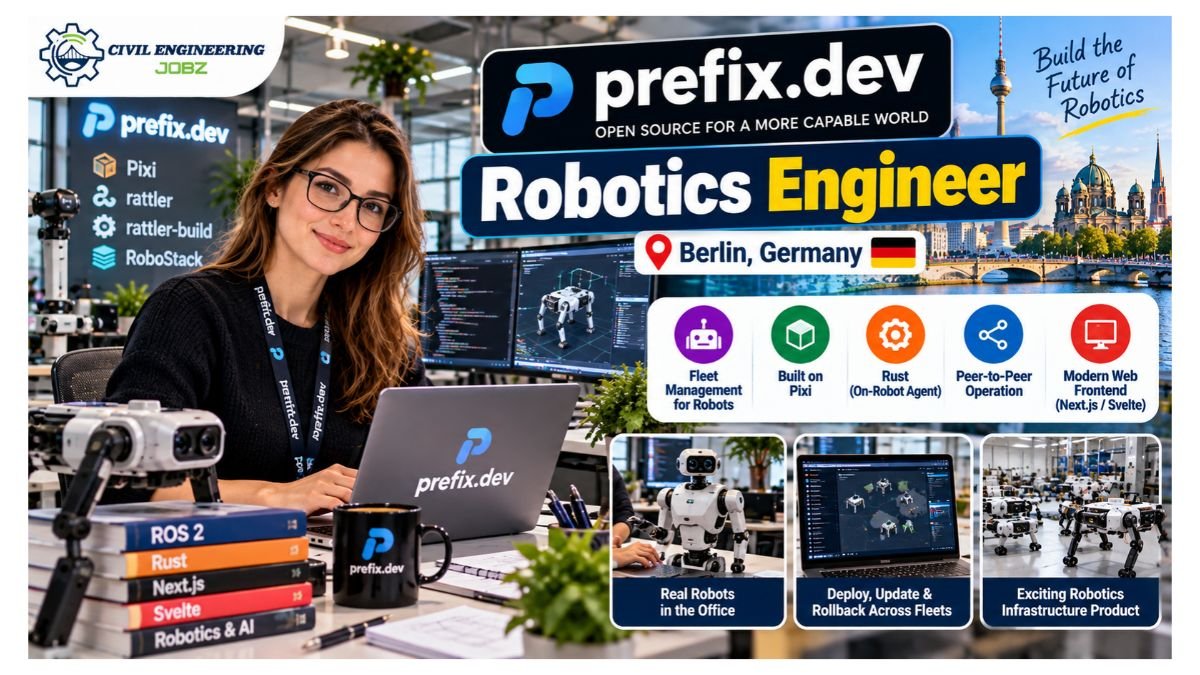
prefix.dev — the open-source team behind Pixi, rattler, rattler-build, and RoboStack, trusted by hundreds of thousands of developers at CERN, in finance, biotech, and an increasingly large slice of the global robotics community — is hiring a Robotics Engineer in Berlin, Germany to build a brand-new product from the ground up: fleet management for robots, built on Pixi. The idea is elegant and powerful — if every robot in a fleet runs a Pixi environment, deploying, updating, and rolling back software across the entire fleet becomes dramatically simpler and more reliable. You describe what the fleet should run; the robots get there — whether they sit in one lab or across multiple sites with unreliable connectivity. The on-robot agent and coordination layer are written in Rust; the networking model targets peer-to-peer operation so the fleet keeps working without a central server or a stable internet connection; and operators manage everything through a modern web frontend in Next.js or Svelte. This is a rare opportunity to build a genuinely novel robotics infrastructure product from scratch — with real robots in the office, real ROS 2 partners in the field, and the creators of Mamba, Pixi, and RoboStack as your direct collaborators.
About This Robotics Engineer Opportunity — prefix.dev Berlin Germany
Employer: prefix.dev — the team that builds and maintains the core open-source package management infrastructure for the Conda ecosystem, including Pixi (the modern Conda environment and task manager), rattler and rattler-build (Rust-native Conda libraries), and RoboStack (packaging ROS for Conda so it runs on any OS from a single lockfile) — used by hundreds of thousands of developers across finance, scientific computing (CERN), biotech, and a rapidly growing robotics community worldwide
Project: A brand-new product — fleet management for robots, built on top of Pixi — partially funded by Berlin’s Pro FIT innovation programme. The architecture: a Rust-based on-robot agent handles environment reconciliation, health reporting, and atomic updates; a P2P coordination layer enables peer discovery and fleet state sharing without central server dependency; and a Next.js or Svelte operator web UI provides fleet visibility, deployment control, log reading, and rollout management
Team: A distributed European engineering team (Netherlands, Germany, UK, Moldova) with deep roots in open-source systems programming — the creators of Mamba, Pixi, rattler, and RoboStack — now building a Berlin-based robotics product team for this new fleet management venture, with real robots in the Berlin office and active ROS 2 field partners
Open Source: A significant portion of the work will be open source and publicly visible — contributing upstream changes to Pixi, rattler, and RoboStack as the fleet management work requires them — making this a role where your engineering contributions will be seen, used, and appreciated by a global developer community from day one
Why This Robotics Engineer Role at prefix.dev Stands Out
Build a New Product From Scratch — With the People Who Created the Foundation: This is not a maintenance role on an existing robotics codebase, and it is not a large-team environment where individual engineering contributions disappear into a sprint backlog. You will build a new product from the start — architecture decisions, networking model, agent design, UI approach — together with the engineers who created Mamba, Pixi, rattler, and RoboStack. The people who understand the Conda and Pixi infrastructure most deeply are your direct collaborators, and the product you build will be used by the same global robotics community that already depends on RoboStack for ROS deployment.
Rust + ROS 2 + P2P — A Genuinely Rare Technical Stack: Production Rust robotics engineering combined with ROS 2 integration, peer-to-peer distributed systems design, async networking with Tokio, and modern web frontend work in Next.js or Svelte is an exceptionally rare technical combination in the job market. This role builds exactly this profile — giving you deep, production-validated expertise across systems programming, robotics middleware, distributed networking, and product UI that positions you as one of a genuinely small number of engineers in the world with this specific combination of capabilities.
Real Hardware — Real Robots in the Office and in the Field: prefix.dev has robots in the Berlin office and active partners running ROS 2 in field deployments. This is not a simulation-only role: your on-robot agent code will run on physical hardware, your P2P networking design will be validated under real-world connectivity constraints, and the deployment and rollback mechanisms you build will be tested against actual robot fleets operated by real users. The feedback loop between engineering and real-world validation is as tight as it gets in robotics software development.
End-to-End Ownership in a Small Team — Berlin Pro FIT Funded: The explicit expectation here is that you own things end to end — from the on-robot Rust agent through the networking layer, the operator web UI, hardware testing, upstream open-source contributions, user conversations, and documentation. In a small Berlin team building a new product, every engineer shapes the direction of what gets built, how it works, and what it becomes. This is the environment where engineers who want genuine technical ownership, not just ticket execution, thrive and grow fastest.
Position Overview
This Robotics Engineer at prefix.dev in Berlin builds the fleet management product for robots on top of Pixi — working on the on-robot agent in Rust (environment reconciliation, health reporting, orchestrating atomic updates), the P2P networking layer (peer discovery, fleet state sharing, package distribution between robots), the operator web frontend in Next.js or Svelte and its connection to the Rust backend, hardware testing with real robots in the office and with ROS 2 field partners, upstream contributions to Pixi, rattler, and RoboStack as the fleet work demands them, and direct user engagement, documentation writing, and product direction input. The role is on-site at the Berlin office, partially funded through Berlin’s Pro FIT programme, and is best suited to an engineer who is energized by end-to-end ownership, open-source culture, and the intersection of systems programming and real-world robotics.
Why This Role Matters: Deploying, updating, and managing software on a fleet of robots is one of the hardest operational problems in modern robotics — harder, in many ways, than the robotics algorithms themselves. A robot running stale software in a production environment is a safety risk. A fleet where half the robots are on one software version and half on another is a debugging nightmare. A deployment that cannot be reliably rolled back when something goes wrong on a remote site with unreliable internet is an operational crisis waiting to happen. These are not theoretical problems: they are the daily operational reality for every organization running robots in the real world — from warehouse automation systems to agricultural robots to scientific research platforms. The Robotics Engineer who builds the prefix.dev fleet management product is not adding a feature to an existing system. They are architecting and implementing the foundational infrastructure that makes robot software deployment as reliable, reproducible, and operationally manageable as the best modern cloud deployment practices — but for physical machines that must keep functioning when the network goes down, when the central server is unreachable, and when a failed update cannot simply be rolled back with a kubectl command. When your P2P networking layer allows a fleet of robots at a remote site with intermittent connectivity to coordinate software updates among themselves without any central coordination, when your atomic update mechanism allows a fleet operator to roll back a bad deployment across fifty robots in under a minute, or when your Pixi-based environment management allows a robotics team to describe their entire software stack in a single lockfile and deploy it reproducibly across every robot in the fleet regardless of OS or hardware — this is infrastructure engineering with direct, tangible impact on the reliability and safety of physical robotic systems operating in the real world. That is the professional significance and engineering excitement of building the prefix.dev fleet management product.
Key Responsibilities
On-Robot Rust Agent, Fleet Networking & Atomic Update Architecture
- Design and implement the on-robot agent in Rust — the core software component that runs on every robot in the fleet and is responsible for reconciling the robot’s current Pixi environment against the desired state described by the fleet operator, reporting robot health and deployment status back to the coordination layer, and orchestrating atomic software updates using Pixi’s environment management and artifact distribution capabilities — ensuring that every robot in the fleet can reliably and safely transition between software versions, with guaranteed rollback capability when a new version causes problems, regardless of whether the robot has a stable internet connection at the time of the update
- Build the P2P networking layer that allows robots, edge nodes, and operators to communicate and coordinate peer-to-peer without requiring a central server or a stable internet connection — designing and implementing peer discovery mechanisms, fleet state sharing protocols, and package distribution between robots that keep the fleet operational and self-coordinating even in remote or connectivity-constrained environments, drawing on distributed systems techniques including gossip protocols, CRDTs, and content-addressed storage where appropriate to ensure eventual consistency and resilience under real-world network conditions
- Work on upstream changes to Pixi, rattler, and RoboStack as the fleet management product’s requirements surface gaps or opportunities in the underlying Conda infrastructure — contributing to the open-source projects that form the foundation of the fleet management system, ensuring that the improvements needed for fleet-scale robot deployment are shared back with the broader developer community that depends on these tools across finance, scientific computing, biotech, and robotics worldwide
Operator Web UI, Hardware Testing & Field Deployment
- Build and evolve the operator web frontend in Next.js or Svelte — the interface through which fleet operators see the state of every robot in their fleet, monitor deployment progress, read logs from individual robots and across the fleet, control rollout sequencing and pacing, and trigger rollbacks when deployments go wrong — designing an operator experience that is genuinely useful and pleasant to work with, built on a solid understanding of what fleet operators need to see and do quickly and what information overload looks like in a multi-robot operational context
- Test the fleet management system on real hardware in the prefix.dev Berlin office and with active ROS 2 partners running robots in field deployments — validating the on-robot agent’s update reconciliation, the P2P networking layer’s behavior under real connectivity constraints, the rollback mechanisms’ reliability under hardware failure scenarios, and the operator UI’s usability in genuine deployment workflows — ensuring that the product ships with the kind of real-world validation that only physical hardware testing against actual robotic systems can provide
- Talk directly to users, write clear and accurate documentation, and actively participate in shaping what the fleet management product becomes — bringing the engineering perspective to product direction conversations, representing the technical constraints and opportunities that determine what is feasible and what will genuinely serve the robotics community that will use this software to manage their robot fleets, and contributing to the open-source culture of transparency, community engagement, and shared learning that defines prefix.dev’s way of building software
Open Source Contribution, Systems Integration & End-to-End Ownership
- Take genuine end-to-end ownership of the systems you build — from initial architecture and design through implementation, testing, documentation, and production operation — in a small Berlin team where individual engineers are trusted and expected to own their work from the first line of code to the first user deployment, and where the feedback from that ownership directly shapes the next round of technical decisions and product direction choices
- Integrate the fleet management system with ROS 2 and the broader ROS ecosystem — leveraging the existing RoboStack infrastructure that packages ROS for Conda, and building the integration points that allow ROS 2-based robot software to be managed, deployed, and updated through the Pixi-based fleet management system across diverse hardware configurations, operating systems, and deployment environments that reflect the real heterogeneity of modern robotics infrastructure in research, industry, and field robotics
- Contribute to prefix.dev’s engineering culture of open-source transparency, upstream collaboration, and community engagement — working in the open, sharing technical decisions and trade-offs through public documentation and repository history, engaging with the robotics and Conda developer communities that use and depend on prefix.dev’s tools, and helping establish the fleet management product as a trusted, community-supported infrastructure component in the global robotics ecosystem
Qualifications
Essential Requirements
- Rust, or a strong C++ or Go background with genuine desire to switch — the primary systems programming language for all backend and agent work; experience with async Rust and the Tokio runtime is particularly valuable given the concurrent, networked nature of both the on-robot agent and the P2P coordination layer; engineers with strong C++ or Go backgrounds and real motivation to work in Rust are explicitly welcome, and the team recognizes that solid systems programming fundamentals transfer effectively across languages with the right learning investment
- Some frontend work with React/Next.js, Svelte, or Vue — not requiring designer-level visual polish, but genuine care about whether the operator UI is pleasant, functional, and efficient to use; the fleet management operator interface is a real product that real operators will depend on, and it deserves an engineer who builds frontend features with the same quality mindset they bring to systems code
- Some robotics background — ROS or ROS 2 experience from any context: a university robotics project, a hobby robot, a research lab, or a job at a robotics company; the domain knowledge to understand how ROS 2 nodes communicate, how robot software is structured, and what operators actually need when managing fleets of physical robots is essential for making good product and architecture decisions in this role
- Comfort with Linux, basic networking, and the command line — the foundation for all development, debugging, and hardware testing work in a systems-level robotics engineering role where the development environment, the robot runtime, and the networking layer all live at the OS level
- You like owning things end to end in a small team — the disposition, confidence, and accountability to take a system from design through implementation, testing, documentation, and production without needing a large support structure, and to represent your engineering decisions to users and teammates with clarity and honesty
- You live in Berlin or are genuinely willing to relocate here — the role is on-site at the Berlin office, which is a real requirement given the hardware testing work, the Pro FIT funding conditions, and the value of in-person collaboration in a small team building a new product from scratch
Advantageous
- Experience with distributed systems or P2P — gossip protocols, CRDTs, content-addressed storage, or any practical exposure to the class of problems that arise when you try to coordinate state across nodes without a central authority and under unreliable network conditions
- Experience with Conda or Pixi — familiarity with the environment management model, the package format, the lockfile approach, and the reproducibility guarantees that make Conda-based deployment so well-suited to the fleet management use case
- Experience shipping software to devices in the field — the practical operational knowledge of what goes wrong when software runs on physical hardware in environments you do not control, and what good deployment, update, and rollback infrastructure looks like in practice
- Open-source contributions — any public record of contributing to open-source projects, in any language or domain, that demonstrates comfort working in the open, collaborating asynchronously with a distributed community, and maintaining code quality standards under public scrutiny
Why Berlin — Germany’s Robotics & Deep Tech Capital
Berlin has established itself as one of Europe’s leading hubs for robotics, deep tech, and open-source engineering talent — a city where academic robotics research from TU Berlin, FU Berlin, and the Charité intersects with a thriving startup ecosystem, established industrial robotics companies, and a global developer community that makes Berlin one of the world’s most exciting cities to work in robotics infrastructure. The prefix.dev Berlin office sits at the heart of this ecosystem — a team building open-source robotics infrastructure tools that are already used by the global scientific and engineering community, now extending into fleet management for a robotics market that is growing rapidly across warehouse automation, agricultural robotics, research platforms, and service robotics deployments worldwide. For engineers who want to build systems that matter — software that runs on real robots, in real deployments, at real organizations — and who want to do it in Berlin, in open source, with the people who created the foundational infrastructure that the global Conda and ROS ecosystem depends on, the prefix.dev Robotics Engineer role in 2026 represents one of the most compelling opportunities available in European robotics software engineering today.
Career Excellence: Rust (Async/Tokio), ROS 2, Pixi, Conda, P2P Networking, Gossip Protocols, CRDTs, Content-Addressed Storage, Next.js, Svelte, Linux Systems Engineering, Robot Fleet Management, Open Source Contribution, Edge Deployment — Robotics Engineer, prefix.dev, Berlin, Germany 2026.
Who Should Apply?
- Rust Systems Engineers with Robotics Interest — Berlin Germany 2026: Engineers with strong async Rust (Tokio) skills and genuine interest in robotics — ready to join a small Berlin team building fleet management infrastructure for ROS 2 robots, working end-to-end across agent code, P2P networking, web UI, and hardware testing in a fully open-source environment alongside the creators of Mamba, Pixi, and RoboStack
- ROS 2 Developers Seeking Systems Engineering Depth — Germany 2026: ROS 2 engineers with C++ or Python backgrounds who want to deepen into systems programming with Rust, P2P distributed systems, and Conda-based deployment infrastructure — in a role that applies genuine robotics domain knowledge to the fleet management and software deployment challenges that every serious robotics organization faces
- Open Source Contributor Engineers — Conda Robotics Berlin: Engineers with open-source contribution experience, Conda or Pixi familiarity, and a robotics or systems programming background — seeking a Berlin role where the majority of their engineering work is public, community-facing, and directly used by the global robotics and scientific computing developer community that depends on prefix.dev’s tools
- Field Robotics Software Engineers — Berlin Startup 2026: Engineers with experience shipping software to robots or edge devices in real-world field deployments — bringing the operational perspective and deployment engineering knowledge that makes fleet management software genuinely reliable in the harsh connectivity and hardware variability conditions of real robotics deployments, in a well-funded Berlin startup environment with real hardware, real users, and genuine product ownership
- Full-Stack Systems Engineers — Rust Frontend Berlin Germany: Seeking a Robotics Engineer position in Berlin at prefix.dev — where Rust systems programming, ROS 2 robotics integration, Pixi/Conda deployment infrastructure, P2P distributed networking, Next.js/Svelte operator UI development, real hardware testing, upstream open-source contribution, and genuine end-to-end product ownership combine in a technically exceptional, open-source-first, and professionally meaningful robotics infrastructure engineering career at one of Europe’s most respected developer tooling companies

Recently Opening Job👇