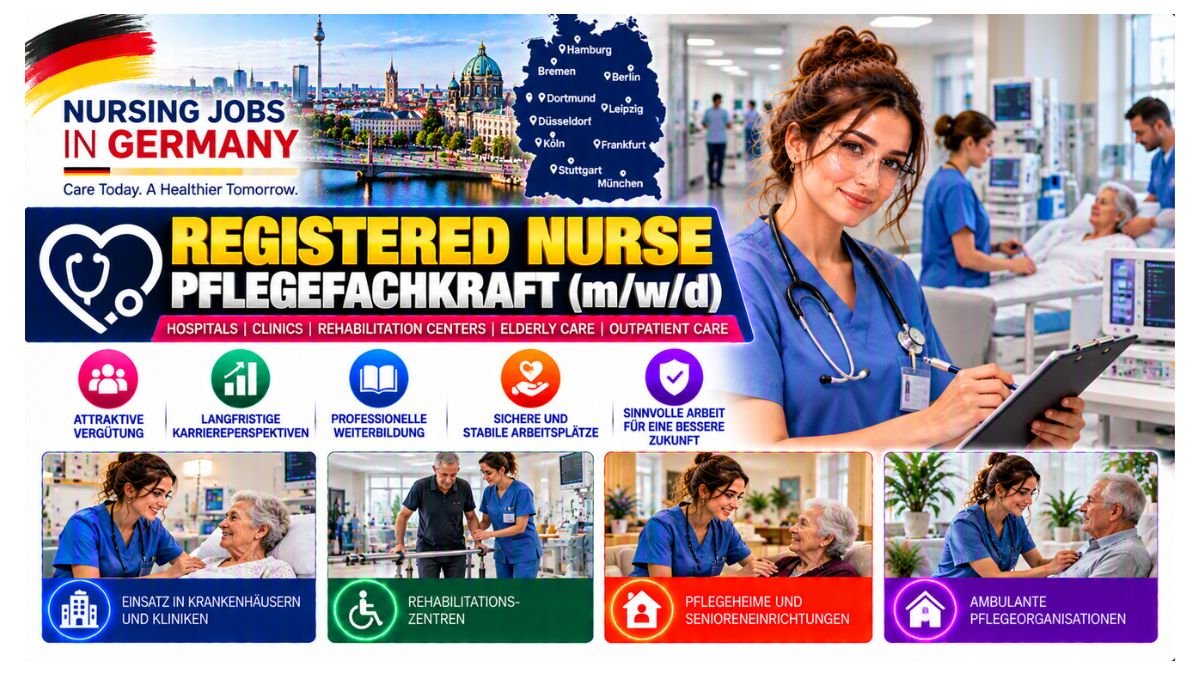
Experienced Registered Nurses and Pflegefachkräfte (m/w/d) are urgently needed to join hospitals, clinics, rehabilitation centers, elderly care facilities, and outpatient healthcare organizations across Germany — including major cities such as Berlin, Hamburg, Munich, Frankfurt, Cologne, Stuttgart, Düsseldorf, Leipzig, Dortmund, Bremen, and other regions. These are permanent, full-time nursing positions across Germany’s most professionally respected and well-resourced healthcare settings — offering competitive salaries, long-term career stability, professional development, and the deeply fulfilling work of providing exceptional clinical nursing care to patients who genuinely need it. Roles are ideal for nurses already in Germany who are passionate about patient care and looking for stable, long-term career opportunities. Germany language skills at B2 level or higher are required. German professional recognition (Anerkennung) must be completed or actively in progress.
Important Eligibility Requirement — Germany Residents Only
These positions are open only to candidates currently residing in Germany and holding the legal right to live and work in Germany.
Applicants from outside Germany will not be considered for these specific openings unless they already have a valid German residence and work permit.
German professional recognition (Anerkennung) must be completed or formally in progress at the time of application.
German language proficiency at minimum B2 level is required for all positions — for safe clinical practice and effective multidisciplinary team communication.
Hiring Locations — Nursing Positions Available Across Germany
Major Cities: Berlin · Hamburg · Munich (München) · Frankfurt am Main · Cologne (Köln) · Stuttgart · Düsseldorf · Leipzig · Dortmund · Bremen
Additional Regions: Other cities and regions across Germany — multiple openings available simultaneously in both large urban centers and smaller regional healthcare facilities
Settings: Acute care hospitals (Krankenhäuser) · Specialist clinics (Fachkliniken) · Rehabilitation centers (Rehabilitationskliniken) · Elderly care facilities (Alten- und Pflegeheime) · Outpatient care services (ambulante Pflege)
Work Model: On-site — shift work including weekends and public holidays as required by each specific employer and care setting
What Employers Offer — Benefits & Working Conditions
Salary: Competitive salary package — depending on qualification, experience, location, specialization, and specific employer | Many roles governed by collective agreements (Tarifvertrag TVöD, TV-L, AVR, or equivalent)
Contract: Permanent employment opportunities (unbefristete Stellen) across multiple healthcare settings in Germany — long-term career stability from day one
Facilities: Modern healthcare facilities and professional working environments — well-equipped clinical settings with up-to-date medical and nursing technology
Development: Training and professional development opportunities — continuing education in nursing specializations, clinical skills, and leadership development
Career Growth: Career advancement opportunities within nursing specialties — from ward nurse through to senior nurse, charge nurse, ward manager, or specialist nursing roles
Teams: Supportive, collaborative, and multidisciplinary medical and nursing teams — professional environments where nursing is valued and respected as a core healthcare discipline
Why Now Is the Right Time to Advance Your Nursing Career in Germany
Germany’s Nursing Shortage: Germany’s structural nursing shortage — affecting hospitals, clinics, rehabilitation, elderly care, and outpatient settings alike — creates exceptional employment security, competitive compensation, and career advancement opportunities for Germany-based qualified nurses who meet the language and recognition requirements
Multiple Cities, Multiple Choices: With nursing vacancies simultaneously open in Berlin, Hamburg, Munich, Frankfurt, Cologne, Stuttgart, and many other locations, Germany-resident nurses can genuinely choose the city, healthcare setting, and specialization that best matches their personal, professional, and family priorities
Tarifvertrag Protection: Many German healthcare nursing roles operate under collective agreements (TVöD, TV-L, AVR) that provide robust salary protection, defined working hours, regulated overtime compensation, and structured career grading — making German nursing employment significantly more transparent and professionally protected than many comparable countries
Professional Development: Germany’s investment in nursing professional development — through structured training programs, specialist nursing qualifications (Fachweiterbildungen), and university-level advanced nursing programs — creates an excellent foundation for career growth for nurses who want to advance beyond the ward level
Role Overview — Registered Nurse / Pflegefachkraft in Germany
These Registered Nurse / Pflegefachkraft (m/w/d) positions across Germany are full-time, permanent clinical nursing roles within hospitals, clinics, rehabilitation centers, elderly care facilities, and outpatient care services, providing direct patient care to the full range of patient groups that each specific care setting serves. Daily responsibilities include providing professional nursing care and monitoring patient health conditions and vital signs; administering medications and treatments according to medical instructions; supporting patient mobility, personal care, and daily activities; preparing and maintaining accurate nursing documentation and care plans; assisting with wound care and clinical procedures; communicating effectively with doctors, patients, and family members; following hygiene, safety, and quality standards to the German healthcare regulatory requirements; and participating in shift handovers and multidisciplinary teamwork in a German-language professional environment. The roles require a completed nursing qualification (Pflegefachfrau / Pflegefachmann or equivalent), minimum 2+ years of professional nursing experience, completed or in-progress German professional recognition (Anerkennung), and German language at B2 level or higher.
Why Germany-Based Registered Nurses Should Apply to These Nursing Positions in 2026: Registered Nurses and Pflegefachkräfte currently living in Germany — who have completed their German professional recognition (Anerkennung) or are actively in the process, who have German language skills at B2 level or above, and who have 2+ years of professional nursing experience in hospital, clinic, rehabilitation, or care settings — are in an exceptionally strong position in Germany’s nursing job market in 2026. Multiple permanent positions are simultaneously open across Germany’s largest and most desirable cities, with competitive salaries, Tarifvertrag protections, professional development support, and the stable long-term employment that Germany’s regulated healthcare sector reliably provides. For Germany-resident nurses who are ready to move or advance their nursing career — now is exactly the right moment to apply.
Key Clinical Responsibilities
Direct Patient Care — Professional Nursing Standards
- Provide professional nursing care to patients across assigned wards or care settings — applying the nursing knowledge, clinical judgment, and person-centered care approach that German healthcare quality standards require, delivering individualised nursing care that reflects the physician’s treatment plan, the nursing care plan developed for each patient’s specific needs, and the specific standards of the care setting (acute hospital ward, specialist clinic, rehabilitation unit, elderly care facility, or outpatient service) in which the position is held
- Monitor patients’ health conditions and vital signs systematically — conducting regular, accurate, and appropriately documented patient assessments including temperature, blood pressure, pulse rate, respiratory rate, oxygen saturation, pain assessment, neurological observations, and the specific assessment parameters relevant to each patient’s diagnosis and treatment plan, recognizing and escalating early warning signs of clinical deterioration to the treating physician or charge nurse before the patient’s condition becomes critical
- Administer medications and treatments according to medical instructions — applying the prescribed medication administration protocols, patient identity verification procedures, dose calculation checks, and administration record documentation standards that German Arzneimittelrecht and patient safety requirements mandate, identifying and escalating medication concerns (allergies, interactions, dosage discrepancies, route of administration questions) before administration occurs
- Assist with wound care and medical procedures — applying aseptic wound care technique, appropriate wound dressing selection, and systematic wound assessment documentation for post-operative wounds, chronic wounds, pressure injuries, and other wound types relevant to the specific care setting, and assisting physicians and senior nurses during clinical procedures requiring nursing support with the technical competence, instrument preparation knowledge, and patient communication skills that safe, efficient procedural assistance requires
Patient Support, Documentation & Care Planning
- Support patient mobility, personal care, and daily activities — providing the dignified, respectful, and appropriately patient-led support for mobility, bathing, nutrition, oral hygiene, elimination, and other activities of daily living that patients whose health conditions temporarily or permanently limit their independence need from the nursing team, applying the transfer and manual handling techniques that protect both patients and nurses from injury during personal care and mobility assistance
- Prepare and maintain accurate nursing documentation and care plans — producing the complete, precise, and legally sound nursing notes, assessment forms, care plan entries, and handover communications that German healthcare documentation standards (Pflegedokumentation) require, ensuring that the nursing record clearly communicates each patient’s current clinical status, care needs, care plan goals, and any significant events or changes to the oncoming shift team and other healthcare team members
- Communicate effectively with doctors, patients, and family members in German — applying professional healthcare communication skills in German for daily clinical handovers, ward round participation, patient and family information conversations, and interdisciplinary team meetings, using the appropriate communication register for each audience (clinical precision with medical colleagues, accessible and empathetic language with patients and families) to ensure that all parties receive the information they need in a form they can understand and act on
Hygiene, Safety, Team Collaboration & Shift Work
- Follow hygiene, safety, and quality standards to German healthcare regulatory requirements — applying hand hygiene protocols, isolation nursing procedures, aseptic technique standards, medical device hygiene requirements, and the specific infection control measures mandated by the Robert Koch Institut (RKI) guidelines and the employing facility’s hygiene plan, maintaining the infection prevention discipline that protects patients, colleagues, and the nurse themselves from healthcare-associated infections in a German clinical environment
- Participate actively in shift handovers and multidisciplinary teamwork — contributing accurate, structured, and complete patient status handovers at shift change using the ISBAR or equivalent structured communication framework adopted by the employing facility, participating constructively in ward rounds, care conferences, and quality improvement initiatives, and building the collaborative working relationships with medical, therapy, and support colleagues that make multidisciplinary patient care genuinely integrated and consistently excellent
- Work shifts including weekends and public holidays as required — demonstrating the professional commitment and personal flexibility that shift-based nursing in Germany’s healthcare system requires, including early, late, and night shifts according to the duty roster as agreed with the employer at the time of appointment
Required Qualifications, Language & Professional Recognition
Nursing Qualification (Required): Completed nursing qualification as Pflegefachfrau / Pflegefachmann (generalist nursing — the current German nursing qualification from 2020 reform), Gesundheits- und Krankenpfleger/in (older German qualification), or equivalent recognized EU or third-country nursing qualification
Experience (Required): Minimum 2+ years of professional nursing experience — in hospital, clinic, rehabilitation, elderly care, or outpatient nursing settings
German Recognition (Required): German professional recognition (Anerkennung / Berufserlaubnis) completed — or formally in progress at a competent German authority | EU qualification: automatic recognition | Third-country qualification: Anerkennung required
German Language (Required): German at minimum B2 level — for safe clinical practice, accurate patient communication, team collaboration, and nursing documentation | C1 level preferred for complex clinical communication and documentation quality
Care Settings: Experience in hospitals · rehabilitation · elderly care · or outpatient care — any combination considered
Personal Qualities: Patient-focused · Responsible · Compassionate · Team-oriented · Reliable · Willing to work shifts including weekends and public holidays
About Registered Nursing Careers Across Germany in 2026
Germany’s registered nursing job market in 2026 is one of the most employment-secure, professionally supportive, and career-advancing nursing markets available to qualified nurses anywhere in Europe — where structural labour shortages in every care setting create genuine competition between healthcare employers for qualified, German-proficient nurses, and where the regulatory framework of Tarifverträge, Arbeitszeitgesetze, and Berufsgesetze provides the professional protections that make German nursing employment consistently more structured, transparent, and personally sustainable than nursing in many other markets. For Germany-resident Pflegefachkräfte and Registered Nurses who have completed or are completing their recognition process, who have developed German language proficiency to B2 level or above, and who have 2+ years of nursing experience across any combination of acute, rehabilitation, elderly care, or outpatient settings — the combination of multiple simultaneous permanent vacancies across Germany’s largest cities, competitive Tarifvertrag-governed salaries, genuine professional development investment by German healthcare employers, and the deeply meaningful work of providing excellent nursing care to patients who need it makes 2026 one of the most professionally rewarding and personally fulfilling times to be a qualified nurse actively building a career in Germany’s healthcare system.
Your Career Growth Path: Registered Nurse / Pflegefachkraft → Senior Nurse (Praxisanleiter) → Charge Nurse / Stationsleitung → Ward Manager / Pflegedienstleitung → Nursing Director / Pflegedirektion — or specialist nursing qualification (Intensivpflege, Anästhesie, OP-Pflege, Onkologiepflege, Geriatrie) toward a specialized senior nursing career role in Germany’s exceptional healthcare system.
Who Should Apply?
- Pflegefachkräfte — Currently in Germany (2+ Years): German-qualified or recognition-completed nurses living in Germany with 2+ years of nursing experience who want to change employer, city, or care setting and find a permanent nursing position that better matches their professional goals and personal preferences
- EU-Qualified Nurses — Germany Residents: Nurses from Spain, Portugal, Romania, Poland, Greece, Croatia, or other EU member states who are currently living in Germany with automatic recognition of their EU nursing qualification and German language at B2+ level, looking for permanent full-time nursing positions across Germany’s major cities
- Anerkennung-Completed International Nurses — Germany Based: Nurses from third countries (Philippines, India, Bosnia, Serbia, Tunisia, Ukraine, or other non-EU countries) who are currently living in Germany with completed German Anerkennung / Berufserlaubnis and B2+ German language, actively seeking permanent nursing employment
- Nurses in Adaptation Period / Kenntnisprüfung — Germany: Nurses currently completing the Anpassungsqualifizierung (adaptation period) or preparing for Kenntnisprüfung in Germany who want to begin the application process now so that they can transition directly into permanent employment upon recognition completion
- Agency or Temporary Nurses — Ready for Permanence: Nurses currently working through German nursing agencies or in temporary nursing positions who want to transition to permanent, directly employed nursing positions with the full employment protections, Tarifvertrag salary grading, and long-term career development that direct healthcare employer employment provides

Recently Opening Job👇