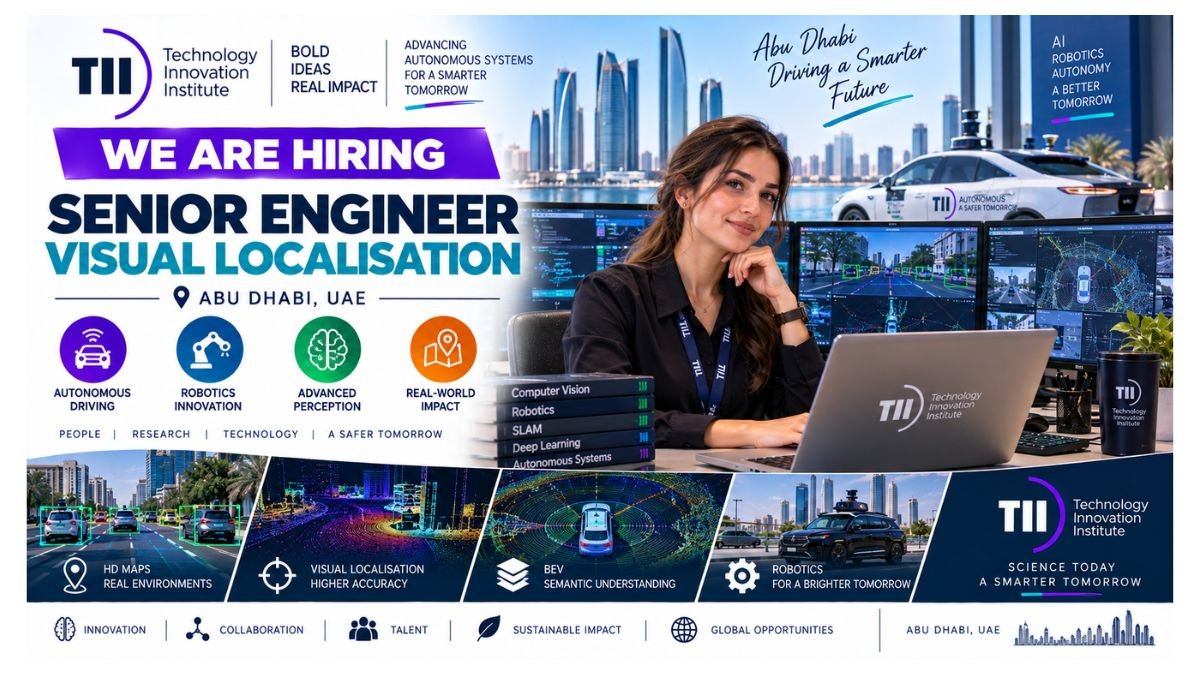
An autonomous driving and robotics technology organization based in Abu Dhabi, UAE is seeking a technically exceptional Senior Engineer — Visual Localisation to lead the development of advanced visual localization solutions for autonomous driving and robotics applications. The role’s primary focus is map-based localization — designing and implementing frameworks that align live semantic observations with High-Definition (HD) maps to enable accurate vehicle positioning in complex urban environments. The successful candidate will leverage Bird’s Eye View (BEV) feature representations, differentiable pose estimation solvers, neural matching approaches, camera-based SLAM, Visual-Inertial Odometry (VIO), and non-linear optimization frameworks including Ceres, g2o, and GTSAM — implemented in production-quality C++17/C++20 and Python within ROS 2. A Master’s or PhD in Robotics, Computer Science, Computer Engineering, or Electrical Engineering is required.
About the Role — Senior Engineer Visual Localisation, Abu Dhabi UAE 2026
Domain: Autonomous driving & robotics localization — map-based positioning for complex urban environments
Technical Core: HD map alignment · BEV localization · SLAM · VIO · Differentiable optimization · Neural pose estimation · Bayesian filtering
HD Map Formats: Lanelet2 · OpenDRIVE — semantic feature alignment with vectorized map layers
Frameworks: PyTorch · PyPose · Theseus · Ceres · g2o · GTSAM | C++17/20 · Python · ROS 2
Collaboration: Cross-functional with Perception · Navigation · Control · Planning teams for full autonomous system integration
Why This Senior Visual Localisation Engineer Role in Abu Dhabi Is a Career-Defining Opportunity
Abu Dhabi AI & Autonomy Hub: Abu Dhabi has established itself as one of the world’s most actively funded and technically ambitious autonomous vehicle and robotics research and deployment environments — home to MBZUAI, TII, G42, and a growing cluster of autonomous systems companies that make it one of the most professionally stimulating places on earth to work on autonomous driving localization
Frontier Technical Scope: Leading the development of BEV-based HD map localization using differentiable optimization and neural pose estimation is genuinely at the frontier of the autonomous driving perception stack — work that simultaneously advances the field and builds the most commercially valuable localization engineering credentials available
Full Stack Ownership: From algorithm design through ROS 2 integration and production deployment — end-to-end technical ownership of the localization pipeline at a scope that junior or mid-level roles cannot provide
Tax-Free Abu Dhabi: Highly competitive senior robotics engineering compensation — zero personal income tax in Abu Dhabi, UAE
Position Overview
This Senior Engineer — Visual Localisation role in Abu Dhabi is a full-time, senior technical position at the core of an autonomous driving and robotics organization’s localization engineering function. You will design and implement algorithms that align live semantic detections (lane markings, stop lines, road boundaries, traffic-related features) with vectorized HD map layers in Lanelet2 and OpenDRIVE formats, develop localization modules using Bird’s Eye View (BEV) feature representations for spatial association and high-accuracy vehicle pose estimation, implement and optimize differentiable pose estimation solvers and neural matching approaches, design and develop camera-based SLAM and Visual-Inertial Odometry (VIO) solutions for urban environments, integrate localization with navigation, planning, and vehicle control systems, collaborate across multidisciplinary perception, navigation, and control teams, research and implement state-of-the-art visual localization and state estimation techniques, and continuously improve software architecture, performance, scalability, and reliability. The role demands expert-level C++17/20 and Python programming, strong ROS 2 experience, deep knowledge of non-linear optimization frameworks (Ceres, g2o, GTSAM), Bayesian filtering, Lie group mathematics, and extensive experience with HD map-based localization in production autonomous driving software stacks.
Why This Senior Visual Localisation Engineer Role Is the Autonomous Driving Career of 2026 in Abu Dhabi: Senior robotics engineers who combine a Master’s or PhD background in robotics, computer science, or electrical engineering with extensive HD map-based localization experience (Lanelet2, OpenDRIVE), proven BEV feature representation and neural pose estimation capability, expert non-linear optimization and state estimation framework knowledge (Ceres, g2o, GTSAM), production C++17/20 and Python engineering skills in ROS 2, and deep mathematical foundations in Lie group theory (SO3, SE3) and Bayesian filtering — represent the most genuinely rare, most technically distinguished, and most rapidly career-advancing engineering talent profile in Abu Dhabi’s extraordinary and rapidly expanding
autonomous driving and AI ecosystem in 2026.
Key Responsibilities
HD Map-Based Localization — Semantic Alignment & Pose Estimation
- Design and implement algorithms that align live semantic detections with vectorized HD map layers — developing the core localization algorithms that take real-time semantic observations from the vehicle’s perception system (lane markings, stop lines, road boundaries, traffic signs, crosswalks, and other map-relevant features detected by the vehicle’s cameras) and precisely associate them with the corresponding elements in the Lanelet2 or OpenDRIVE HD map representation, computing accurate vehicle pose estimates from the geometric correspondence between observed features and their mapped positions
- Develop Bird’s Eye View (BEV) localization modules for high-accuracy vehicle pose estimation — implementing the BEV feature extraction, projection, and spatial association architectures that transform multi-camera perspective images into top-down feature representations that can be efficiently and accurately aligned with the 2D vector map representation of the operating environment, enabling precise vehicle position and orientation estimation without requiring expensive 3D point cloud matching
- Implement and optimize differentiable pose estimation solvers and neural matching approaches — replacing or augmenting traditional geometric association and Kalman filtering-based pose estimation with end-to-end differentiable localization pipelines that can be trained jointly with the upstream feature extraction networks, improving localization accuracy and robustness in challenging conditions where traditional handcrafted feature detectors and geometric matchers struggle to perform reliably
- Assess and define NTE localization accuracy requirements for design-sensitive autonomous driving scenarios — understanding the specific positioning accuracy requirements of planning, control, and safety-critical decision-making components to define the localization error budgets that the visual localization system must achieve, and designing the algorithm and system architecture to meet these requirements across the full range of operating conditions the autonomous system will encounter
SLAM, VIO & State Estimation Architecture
- Design and develop robust camera-based SLAM solutions for urban and structured autonomous driving environments — implementing the visual SLAM architectures (keyframe selection, loop closure detection, bundle adjustment, and map management) that provide accurate and drift-free vehicle positioning in the absence of HD map coverage or during HD map initialization, applying state-of-the-art learned feature descriptors and geometric verification approaches that provide reliability across the lighting, weather, and appearance variation conditions of urban autonomous driving
- Develop Visual-Inertial Odometry (VIO) solutions — implementing tightly coupled or loosely coupled IMU preintegration and camera measurement fusion frameworks using GTSAM, Ceres, or equivalent graph optimization backends to achieve accurate, low-latency vehicle ego-motion estimation that bridges the gap between sparse HD map localization updates and the high-frequency pose estimates required by the vehicle’s planning and control systems
- Apply non-linear optimization and state estimation using Ceres, g2o, GTSAM, or equivalent frameworks — implementing the factor graph formulations, residual definitions, Jacobian derivations, and solver configuration settings that enable efficient, accurate batch and incremental optimization of the localization and mapping estimation problems, applying expert-level knowledge of sparse linear algebra, numerical conditioning, and optimization convergence behavior to achieve reliable performance in production autonomous driving conditions
- Apply Bayesian filtering techniques for robust state estimation — designing the extended Kalman filter, unscented Kalman filter, particle filter, or hybrid filtering architectures that propagate vehicle state uncertainty correctly through motion model predictions and measurement update steps, maintaining well-calibrated uncertainty estimates that accurately reflect the localization system’s confidence in its position and orientation estimates under all operating conditions
Geometric Mathematics & Coordinate Transformation Foundations
- Apply advanced knowledge of Lie groups and Lie algebras (SO3, SE3) — implementing the rigorous mathematical representations of 3D rigid body transformations that are required for correct composition, interpolation, differentiation, and uncertainty propagation of vehicle poses in a consistent, singularity-free mathematical framework, ensuring that the localization system’s geometric reasoning is mathematically sound across all vehicle orientations and motion conditions
- Implement coordinate transformations and 2D/3D geometric reasoning — applying expert-level understanding of camera projection models, sensor-to-vehicle extrinsic calibration, world-to-map coordinate transforms, and 2D/3D geometry to correctly implement the geometric computations that underpin the entire visual localization pipeline from raw image input through to vehicle pose output in the map coordinate frame
- Apply geometric deep learning and spatial data association methods — integrating geometric structure awareness into the neural network architectures used for feature extraction, matching, and pose estimation, leveraging equivariant network designs, graph neural network-based scene representations, and structured prediction approaches that exploit the geometric regularity of road environments to improve localization accuracy and generalization
Production Engineering — C++17/20, Python & ROS 2
- Develop performance-critical, production-quality C++17/C++20 localization software within Linux environments — applying expert-level modern C++ programming to implement the compute-efficient, memory-safe, and maintainable localization algorithms that meet the real-time performance requirements of autonomous driving software stacks, applying modern C++ features including move semantics, template metaprogramming, concurrency primitives, and range-based algorithms to write code that is both performant and readable
- Implement and maintain ROS 2 localization nodes, interfaces, and system integration — designing the ROS 2 node architecture, message interfaces, launch configurations, and parameter management that enable the localization software to integrate cleanly into the broader autonomous driving software stack, applying ROS 2 best practices for real-time communication, quality of service configuration, and system lifecycle management
- Collaborate with Perception, Navigation, Planning, and Control teams for seamless system integration — maintaining the cross-functional technical interfaces that ensure the localization system’s inputs (camera images, IMU data, HD map tiles, initial pose estimates) and outputs (vehicle pose estimates, localization confidence scores, map correspondence data) are correctly defined, efficiently exchanged, and properly consumed by all dependent autonomous system components
Qualifications & Requirements
Educational Requirements
- Master’s or PhD in Robotics, Computer Science, Computer Engineering, Electrical Engineering, or a closely related field — the academic foundation for the mathematical depth (Lie group theory, Bayesian estimation, non-linear optimization) and research capability (state-of-the-art literature evaluation and implementation) that this role demands
Core Technical Requirements
- Extensive experience with HD map-based localization using Lanelet2, OpenDRIVE, or comparable HD map formats — with demonstrated production or research track record of implementing semantic feature-to-map alignment for autonomous vehicle localization
- Strong background in differentiable optimization, neural pose estimation, and ML frameworks (PyTorch, PyPose, Theseus, or similar) — for implementing learned localization and neural matching approaches
- Proven expertise in non-linear optimization and state estimation using Ceres, g2o, GTSAM, or equivalent — for SLAM and VIO implementation
- Expert-level C++17/20 and Python programming within Linux environments, with strong ROS 2 experience for robotics platform development
About Visual Localisation & Autonomous Driving in Abu Dhabi 2026
Visual localization — the ability of an autonomous vehicle to determine its precise position and orientation within a known environment using camera-based observations matched against a pre-built HD map — sits at the absolute technical heart of safe autonomous driving. Without accurate, reliable, and robust localization, every downstream system in the autonomous stack — perception, prediction, planning, and control — operates on an incorrect understanding of where the vehicle is in the world, with consequences that range from uncomfortable to catastrophic. The specific challenge of achieving the centimeter-level positioning accuracy that safe autonomous driving demands, using only camera imagery matched against semantic HD maps across the full range of lighting conditions, weather states, and seasonal appearances that real-world urban environments present, represents one of the most intellectually demanding and technically consequential engineering problems in the entire autonomous driving field. Abu Dhabi’s position as one of the world’s most actively funded and seriously committed autonomous vehicle research and deployment cities — backed by the UAE government’s extraordinary AI investment programs and the presence of MBZUAI, TII, and G42’s autonomous systems initiatives — makes it one of the most professionally stimulating environments on earth for a Senior Visual Localisation Engineer to apply their expertise, contribute to a genuinely important challenge, and build a career-defining body of work in 2026.
Your Career Growth Path: Senior Engineer Visual Localisation → Principal Engineer Localisation → Technical Lead — Autonomous Localisation → Director of Localisation & Mapping → VP Autonomous Systems Engineering — a globally recognized, mathematically distinguished, and professionally consequential autonomous driving engineering career built at the frontier of one of the most technically demanding and commercially significant challenges in modern robotics and AI.
Who Should Apply?
- PhD/MSc Robotics Engineers — Localization Specialization: With research or production experience in visual SLAM, VIO, or HD map-based localization for autonomous driving or robotics who want a senior technical role in Abu Dhabi’s extraordinary autonomous systems ecosystem
- Autonomous Driving Localization Engineers — Tier 1 / OEM: With experience at Waymo, Mobileye, Cruise, Argo AI, Motional, Aptiv, or equivalent autonomous vehicle companies working on visual localization, HD map localization, or sensor fusion who want a senior engineering role in the UAE
- Visual SLAM & VIO Researchers Transitioning to Industry: With strong academic publication records in visual SLAM, VIO, differentiable SLAM, or neural localization who want to apply their research expertise in a production autonomous driving environment in Abu Dhabi
- BEV Perception / Localization Engineers: With hands-on experience developing Bird’s Eye View representations for autonomous driving — specifically applied to map alignment or localization tasks — who want to lead BEV localization development at a growing autonomous driving organization
- Robotics Engineers — C++/ROS2 Experts: With expert-level production C++17/20 robotics software development and ROS 2 integration experience in autonomous driving or industrial robotics contexts, combined with strong state estimation and optimization backgrounds

Recently Opening Job👇