Application Deadline — Act Now
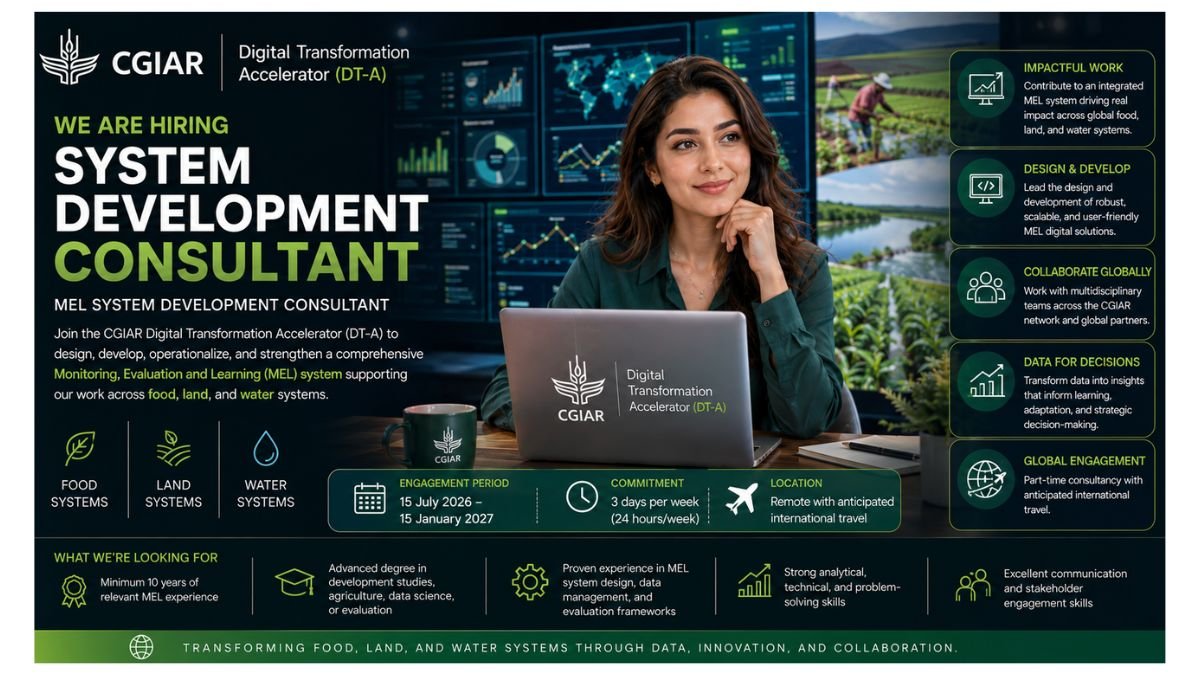
Deadline: 08 July 2026 at 11:59 PM CET. Applications must be submitted online only. CVs and cover letters must be in English. Do not include marital status, age, or photograph. Applications via email will NOT be acceptedThe CGIAR Digital Transformation Accelerator (DT-A) is seeking an expert MEL System Development Consultant to design, develop, operationalize, and strengthen a comprehensive Monitoring, Evaluation and Learning (MEL) system supporting the DT-A’s work across food, land, and water systems. This is a part-time consultancy engagement of 3 days per week (24 hours/week) running from 15 July 2026 to 15 January 2027, with anticipated international travel. Candidates must hold a minimum of 10 years of relevant MEL experience and an advanced degree in development studies, agriculture, data science, or evaluation.
About CGIAR Digital Transformation Accelerator (DT-A)
Organization: CGIAR Digital Transformation Accelerator (DT-A)
Mission: Leverage digital technologies, AI, and data science to accelerate transformation of food, land, and water systems
Engagement Type: Consultancy with anticipated travel — 3 days/week (24 hours/week)
Duration: 15 July 2026 — 15 January 2027 (6 months)
MEL Scope: DT-A Accelerator level and Areas of Work (AoWs) — pooled and bilateral funding streams
Why This MEL Consultancy Is a Premier International Career Opportunity
Global Impact: Design MEL systems that track AI and digital innovation outcomes across food, land, and water systems worldwide
CGIAR Prestige: Work with one of the world’s most respected agricultural research and digital innovation networks
AI-Enabled MEL: Lead integration of AI analytics tools, digital dashboards, and innovative data collection approaches
Inclusive Culture: CGIAR is committed to diversity, equity, and inclusion across all cultures, backgrounds, and identities
Assignment Overview & Objective
This MEL System Development consultancy requires the selected expert to develop and support the implementation of a best-in-class Monitoring, Evaluation and Learning system that is fully responsive to the entrepreneurial and adaptive nature of the CGIAR Digital Transformation Accelerator. The MEL system must support performance management, accountability to stakeholders and donors, evidence-based decision-making, and learning — while specifically capturing the emergence, testing, scaling, and adoption of digital innovations across food, land, and water systems. The assignment is structured across three core activity phases spanning theory of change review, MEL framework development, and full system operationalization with digital and AI-enabled tools.
Why Apply for This MEL Consultancy Opportunity: MEL System Development roles within CGIAR and global digital innovation programs represent some of the most intellectually stimulating, globally impactful, and professionally prestigious consultancy opportunities available to senior evaluation and learning specialists. This assignment places you at the intersection of digital transformation, AI-enabled analytics, and global food systems — designing the evidence infrastructure that will shape how one of the world’s most ambitious agricultural digital transformation programs is monitored, learned from, and scaled. Applications close 08 July 2026 — do not delay.
Key Responsibilities — Three Activity Phases
Activity 1 — Theory of Change Review & MEL Objectives (Weeks 1–4)
- Work in close consultation with the DT-A Director, CGIAR partners, and selected stakeholders to clearly define the MEL system’s objectives and strategic priorities across the Accelerator
- Review and refine the existing Theory of Change (ToC) — identifying intermediate outcomes, underlying assumptions, and causal pathways that connect digital innovation activities to food, land, and water system impacts
- Review the key results framework to ensure full logical alignment between program activities, outputs, outcomes, and impact-level indicators across all DT-A Areas of Work
- Identify critical learning priorities and evidence needs that the MEL system must address to support adaptive management and stakeholder accountability throughout the program
Activity 2 — MEL Framework Development (Weeks 5–12)
- Develop a comprehensive, best-in-class MEL framework articulating clear results pathways, performance indicators, data sources, responsibilities, and reporting mechanisms across all DT-A AoWs
- Formulate a structured set of key learning questions that will guide evidence generation, reflection processes, and adaptive management decisions throughout the DT-A program lifecycle
- Design practical approaches for capturing both planned and emerging outcomes — including approaches suited to tracking digital innovation adoption, scaling, and systems change in complex multi-partner environments
- Recommend innovative digital and AI-enabled tools and methods for data collection, analysis, and reporting — identifying platforms that match the DT-A’s entrepreneurial and adaptive operating model
- Establish clear mechanisms for tracking and documenting partner contributions across the full results chain under both pooled and bilateral funding arrangements
Activity 3 — MEL System Operationalization & Implementation Support (Week 13 Onwards)
- Develop standardized data collection templates, reporting guidelines, and Standard Operating Procedures (SOPs) to ensure consistent, high-quality MEL data across all DT-A Areas of Work and partners
- Support the configuration and deployment of digital MEL platforms, interactive dashboards, and AI-enabled analytics tools that enable real-time performance tracking and evidence-based decision-making
- Establish robust data quality assurance and verification mechanisms — ensuring all MEL data meets the accuracy, completeness, and timeliness standards required for stakeholder and donor reporting
- Facilitate periodic reflection and learning sessions with DT-A teams and partners — creating structured opportunities for adaptive management, course correction, and knowledge exchange
- Support preparation of periodic performance reports, learning products, and knowledge-sharing materials for internal management and external stakeholder communication
Key Deliverables
Expected Outputs from This Assignment
- Refined Theory of Change and Results Framework — with updated intermediate outcomes and evidence-aligned assumptions
- Comprehensive MEL Framework — including indicators, data sources, responsibilities, and reporting arrangements across all AoWs
- Learning Agenda and structured Key Learning Questions for adaptive program management
- Data Collection, Reporting, and Data Quality Assurance tools — templates, SOPs, and guidelines
- Recommendations for Digital and AI-Enabled MEL Solutions — platform and tool specifications
- Partner Contribution Tracking Framework — for pooled and bilateral funding stream accountability
- MEL Dashboard and Reporting Specifications — for real-time performance monitoring and stakeholder reporting
- Periodic Technical Support Reports and Learning Briefs — documenting progress, insights, and adaptive actions
- Final MEL Operationalization and Implementation Guidance Package — for ongoing program use beyond the consultancy period
Qualifications & Requirements
Education
- Advanced degree (Master’s or PhD) in a relevant discipline — including development studies, agricultural science, data science, program evaluation, or a closely related field
Experience Requirements
- Minimum 10 years of relevant professional experience in MEL roles — specifically in MEL system design and implementation within CGIAR, international agricultural research, or complex multi-partner programs
- Demonstrated expertise in Results-Based Management (RBM), Theory of Change development, and results framework design across complex development programs
- Proven experience with digital MEL platforms, data visualization and dashboarding tools, and AI-enabled analytics for performance monitoring and learning
- Demonstrated ability to design adaptive MEL systems suited to innovation-focused, entrepreneurial program environments with rapidly evolving results chains
- Experience facilitating learning processes and structured reflection sessions with diverse, multi-cultural stakeholder groups across international programs
Technical & Sector Skills
- Excellent written English communication skills — able to produce high-quality learning products, technical reports, performance briefs, and knowledge-sharing materials for diverse audiences
- Familiarity with food, land, and water systems and/or digital innovation ecosystems is a strong added advantage for this assignment
- Working knowledge of AI-enabled MEL tools, digital data collection platforms, and interactive dashboard development for international development programs
About CGIAR Digital Transformation Accelerator
The CGIAR Digital Transformation Accelerator (DT-A) is at the forefront of applying digital technologies, artificial intelligence, and data science to accelerate systemic transformation across global food, land, and water systems. Operating as part of the CGIAR network — the world’s largest international partnership dedicated to agricultural research for development — the DT-A brings together leading research organizations, technology innovators, and development partners to test, scale, and adopt digital solutions that can fundamentally improve food security, environmental sustainability, and rural livelihoods at scale. A robust, well-designed MEL system is the critical infrastructure that enables the DT-A to demonstrate impact, learn rapidly, and adapt strategically — making this consultancy one of the most consequential and intellectually rewarding evaluation assignments available in the international development and digital innovation space in 2026.
Who Should Apply?
- Senior MEL Specialists: With 10+ years designing and implementing MEL systems for CGIAR, UN agencies, or complex multi-partner international development programs
- Evaluation & Learning Experts: With Theory of Change, Results-Based Management, and digital MEL platform experience in agriculture, food security, or environmental programs
- Digital MEL Consultants: With hands-on experience deploying AI-enabled analytics tools, interactive dashboards, and digital data collection systems for international program monitoring
- Agricultural Research Evaluators: Familiar with CGIAR’s research and innovation architecture and experienced in evaluating digital transformation or innovation scaling programs
- International Development Consultants: With adaptive MEL system design experience in complex, multi-funder, multi-partner development program environments

Recently Opening Job👇