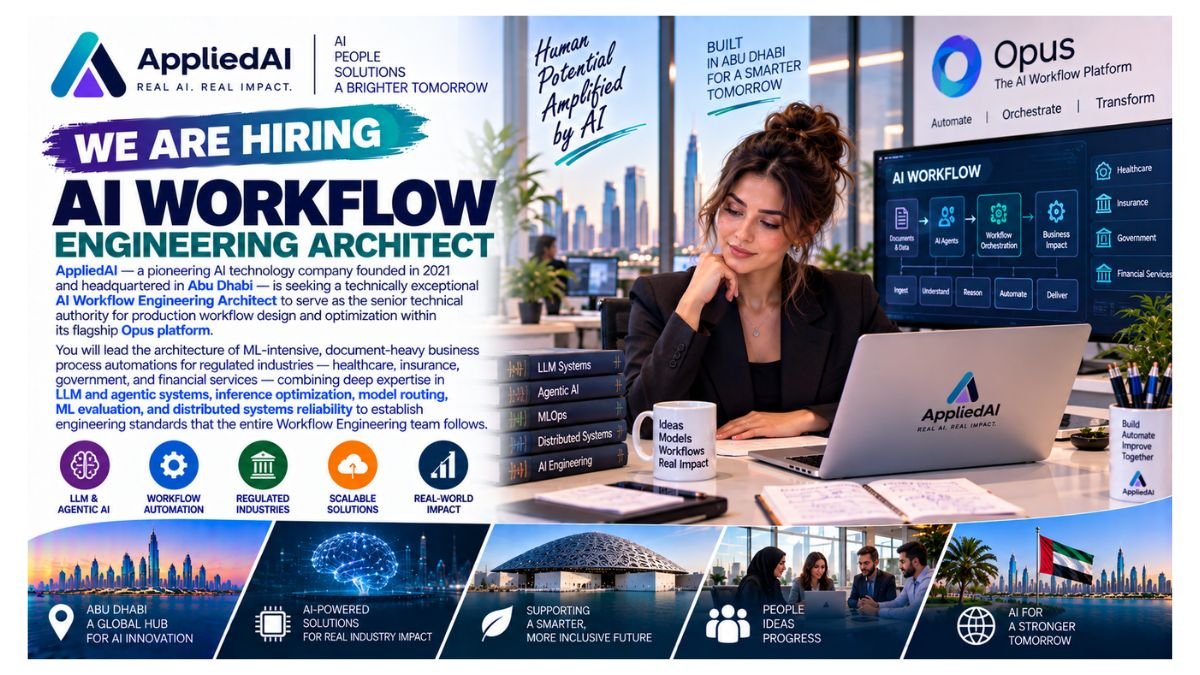
AppliedAI — a pioneering AI technology company founded in 2021 and headquartered in Abu Dhabi — is seeking a technically exceptional AI Workflow Engineering Architect to serve as the senior technical authority for production workflow design and optimization within its flagship Opus platform. You will lead the architecture of ML-intensive, document-heavy business process automations for regulated industries — healthcare, insurance, government, and financial services — combining deep expertise in LLM and agentic systems, inference optimization, model routing, ML evaluation, and distributed systems reliability to establish engineering standards that the entire Workflow Engineering team follows.
About AppliedAI — Opus Platform & Regulated AI
Founded: 2021 — Abu Dhabi-headquartered AI company focused on regulated industry enterprise automation
Platform: Opus — automates and supervises mission-critical, document-heavy processes with embedded governance, auditability, and human oversight
Industries: Healthcare, insurance, government, and financial services — regulated, high-stakes environments where accuracy and reliability are non-negotiable
Technical Scope: LLM/agentic system architecture, inference optimization, model routing and cascades, ML evaluation methodology, distributed systems reliability
Model Ecosystem: Multi-model orchestration across providers including Anthropic, OpenAI, and Gemini — routing, cascades, and fallback strategies
Abu Dhabi AI Sector — Why AppliedAI Now
Strategic Location: Abu Dhabi — the UAE’s national AI capital, with sovereign investment, world-class compute infrastructure, and the most ambitious AI programme in the Middle East
Market Differentiation: AppliedAI is addressing one of the hardest problems in enterprise AI — production-grade LLM and agentic workflow reliability in regulated industries where failure has real operational and regulatory consequences
Architecture Authority: A genuinely rare role — the senior technical custodian of an entire AI platform’s workflow engineering discipline, with direct influence over how production ML is practised across the engineering team
Career Impact: Shape the engineering standards, methods, and reusable patterns that define how a frontier AI platform operates at production scale — building credentials that are globally recognized in the LLM engineering community
Position Overview
This AI Workflow Engineering Architect role at AppliedAI Abu Dhabi is the senior technical authority for the design and optimization of production Opus platform workflows — with particular responsibility for ML-intensive and computationally demanding business processes. You will establish how Opus workflows should be engineered to achieve required accuracy and reliability at the lowest practical inference cost and latency, lead Workflow Engineers through architecture reviews and technical development, define evaluation and experimental methodology standards, lead inference and systems performance analysis, establish reliable execution semantics, define production measurement frameworks, and serve as the final technical custodian of workflow engineering best practice across the team.
Why This Role Matters: As AI Workflow Engineering Architect at AppliedAI Abu Dhabi, you hold one of the most technically demanding and professionally consequential roles in the UAE’s AI sector — serving as the senior authority on how production LLM and agentic workflows are designed, evaluated, optimized, and operated for mission-critical regulated industry applications where accuracy, reliability, and auditability are not optional, apply and elevate expertise in inference optimization, model routing and cascades, ML evaluation methodology, distributed systems reliability, and production ML engineering — in a role where your architectural decisions directly determine whether Opus workflows achieve the accuracy, throughput, latency, and cost targets that enterprise customers in healthcare, insurance, and finance depend on, shape a production ML engineering discipline from the inside — converting your expert knowledge of LLM systems, inference economics, calibrated confidence, and evaluation methodology into engineering standards, reference implementations, and reusable patterns that the entire Workflow Engineering team follows and builds upon, mentor and develop Workflow Engineers into strong ML and computer science practitioners who can make complex architectural decisions independently — building a team capability that multiplies your own technical impact across the organization, and work at the frontier of enterprise AI in Abu Dhabi — contributing to a platform that is solving some of the hardest problems in production LLM engineering, in a company that is genuinely on the edge of what is possible with applied AI in regulated industries.
Key Responsibilities
Workflow Architecture & Optimization
- Lead the decomposition of business processes into efficient Opus workflow graphs — defining execution boundaries, dependencies, state, parallelism, and failure paths
- Formulate workflow design decisions as constrained optimization problems across accuracy, latency, throughput, inference cost, and operational reliability — establishing the appropriate operating point rather than optimizing any metric in isolation
- Lead technical analysis of workflow execution cost and performance — including model inference, context construction, retrieval, serialization, network calls, concurrency, and orchestration overhead
- Establish methods for profiling and improving caching, batching, parallel execution, model size, quantization, context length, and accelerator utilization
Model Architecture, Selection & Routing
- Establish the technical methods by which Workflow Engineers select and compose models within Opus across heterogeneous execution strategies
- Design and review execution strategies including deterministic computation, specialist models, retrieval, model cascades, conditional routing, early exits, and human review
- Require model choice and routing decisions to be supported by measured error rates, calibrated confidence, workload characteristics, and marginal inference economics
- Lead multi-model orchestration architecture across providers including Anthropic, OpenAI, and Gemini — routing, cascades, and intelligent fallback strategies
ML Evaluation, Experimental Methodology & Reliability
- Define engineering standards by which Opus workflows are demonstrated to work — including representative test sets, business-weighted loss functions, component and end-to-end benchmarks, and regression thresholds
- Ensure evaluation covers distribution shift, rare cases, correlated failures, and high-cost errors — not just aggregate model accuracy or successful demonstration cases
- Establish best practice for reliable Opus workflow execution including typed interfaces, idempotency, checkpointing, bounded retries, timeouts, backpressure, and partial-failure recovery
- Apply property-based testing, fault injection, deterministic replay, and execution-trace analysis where appropriate — ensuring Workflow Engineers understand failure as an architectural property
Production Measurement, Technical Leadership & Team Development
- Define how workflow performance is measured after deployment and how production evidence feeds back into engineering decisions — connecting workflow versions, execution traces, errors, latency, inference consumption, and business outcomes
- Lead diagnosis of regressions — determining whether corrective action belongs in workflow structure, data, model choice, routing, context, software implementation, or capacity
- Develop Workflow Engineers into strong ML and computer science practitioners capable of making complex architectural decisions independently
- Maintain reference implementations, engineering standards, and reusable Opus patterns — progressively converting expert knowledge into a repeatable engineering discipline
Qualifications & Requirements
Required Skills
- Senior-level applied ML and software engineering background — hands-on experience designing and operating production LLM/agentic systems (not research-only or prototype-only) (REQUIRED)
- Strong grounding in ML evaluation methodology and systems performance — latency, cost, and concurrency as engineering disciplines, not afterthoughts
- Distributed systems fundamentals — reliability, failure handling, and state management in production pipelines
- Demonstrated experience mentoring engineers and setting technical standards across a team — not just doing the work solo
Desirable Skills
- Experience with multi-model orchestration — routing, cascades, and fallback across providers like Anthropic, OpenAI, and Gemini
- Background in a regulated industry — healthcare, finance, insurance, or BPO environments where accuracy and auditability are critical
- Experience building engineering standards or a technical discipline from scratch in an early-stage, high-growth environment
- Published writing, research, or patents on ML systems or inference optimization — demonstrating external technical thought leadership
About AppliedAI — Regulated AI at Production Scale
AppliedAI, founded in 2021 and headquartered in Abu Dhabi, is a pioneering AI technology company committed to innovation and excellence in artificial intelligence solutions across regulated industries including healthcare, insurance, government, and financial services. Its flagship platform, Opus, automates and supervises mission-critical, document-heavy processes with embedded governance, auditability, and human oversight — helping enterprises achieve measurable productivity gains while increasing operational reliability and trust. Working at AppliedAI means working on some of the hardest problems in production AI engineering, in an environment where the technical decisions you make have real consequence, and where your contribution to the discipline of workflow engineering shapes how an entire platform operates at scale.
Career Excellence: Define the production LLM and agentic workflow engineering discipline at AppliedAI Abu Dhabi — where your inference optimization, model routing, and ML evaluation expertise sets the technical standard for a regulated-industry AI platform serving healthcare, insurance, and government.
Who Should Apply?
- Senior Production LLM/Agentic Systems Engineers: With hands-on architecture and operation of production LLM systems — not research or prototype environments
- ML Systems Architects: With deep expertise in inference optimization, model routing and cascades, evaluation methodology, and distributed systems reliability
- Multi-Model Orchestration Engineers: With experience designing routing, cascade, and fallback strategies across Anthropic, OpenAI, Gemini, or equivalent LLM providers
- Production MLOps Technical Leads: With demonstrated experience setting engineering standards, developing team technical capability, and building repeatable engineering disciplines
- Regulated Industry AI Engineers: With healthcare, insurance, finance, or government AI experience where accuracy, governance, auditability, and reliability are non-negotiable requirements

Recently Opening Job👇