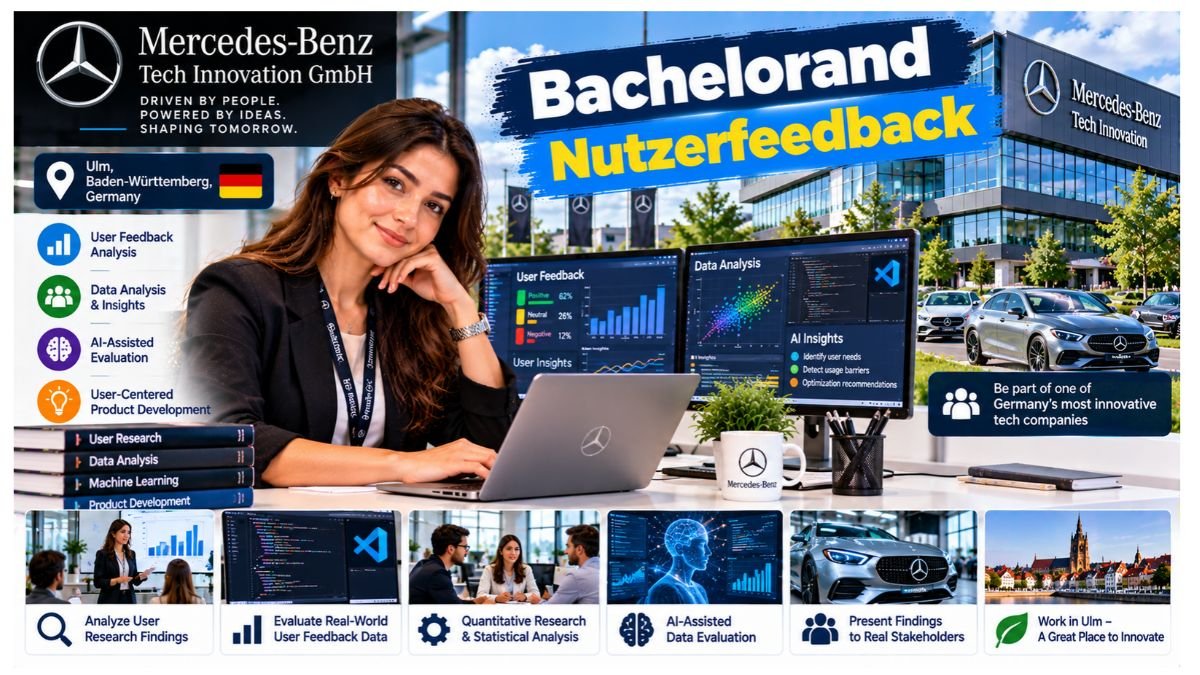
Mercedes-Benz Tech Innovation GmbH — the largest tech company within the Mercedes-Benz Group AG, with around 2,500 employees across Ulm, Stuttgart, Berlin, Karlsruhe, and international tech hubs — is looking for a Bachelorand (Bachelor Thesis Student) in User Feedback & Data Analysis (m/w/d/x) to join its product team in Ulm, Baden-Württemberg. In this role, you will analyze existing user research findings and evaluate real-world user feedback data using quantitative research methods, statistical analysis, and AI-assisted data evaluation — likely using Visual Studio Code — to surface user needs, identify usage barriers, and derive concrete optimization recommendations for user-centered product development. You will take genuine responsibility from day one, present your findings to real stakeholders, and complete your thesis work at the heart of one of Germany’s most innovative and technically ambitious corporate tech organizations — where individual freedom, personal responsibility, and a passion for new technologies are the daily working culture, not a recruitment slogan.
About This Bachelorand Nutzerfeedback & Datenanalyse Opportunity — Mercedes-Benz Tech Innovation, Ulm Germany
Employer: Mercedes-Benz Tech Innovation GmbH — the largest technology subsidiary within the Mercedes-Benz Group AG, employing approximately 2,500 tech professionals at locations including Ulm, Stuttgart, Berlin, and Karlsruhe as well as international tech hubs, working on the technology trends that will define mobility’s future — combining the engineering excellence, global brand credibility, and resource depth of one of the world’s most recognized automotive groups with the agile, innovation-driven culture of a modern tech company that describes itself not as a car manufacturer but as a technology innovator defining the future
Role Focus: Bachelor thesis-level research in user feedback analysis and quantitative data analysis — supporting the team in analyzing existing user research findings, preparing and evaluating quantitative user data for relevant insights, applying AI-assisted data evaluation methods (expected to include Visual Studio Code), conducting statistical analyses to identify meaningful patterns and relationships within user data, deriving user needs, usage barriers, and optimization potentials from analysis results, and developing concrete actionable recommendations for user-centered product development that are presented to stakeholders in audience-appropriate formats with the analytical clarity and communication precision that Mercedes-Benz Tech Innovation’s product teams require
Academic Background: Ideally suited to students completing a bachelor’s degree in UX Design, Psychology, Human-Computer Interaction (HCI), Business Informatics (Wirtschaftsinformatik), Data Science, or a closely related discipline — who bring genuine interest in quantitative research methods and statistical data analysis, curiosity about AI applications in data evaluation, and the analytical thinking and structured working style that transforms raw user data into the product-relevant insights that drive user-centered design decisions at a world-class technology company
Location: Ulm, Baden-Württemberg, Germany — a dynamic, internationally oriented university and technology city on the Danube, home to the University of Ulm, Ulm University of Applied Sciences, and a thriving tech and automotive industry ecosystem anchored by Mercedes-Benz Tech Innovation, Daimler Truck, Wieland, and a growing cluster of digital product and deep-tech companies that make Ulm one of Baden-Württemberg’s most attractive locations for tech-oriented students seeking real-world industry experience during their studies
Why This Bachelorand Role at Mercedes-Benz Tech Innovation Ulm Stands Out
Real Work, Real Responsibility — Not a Coffee-Fetching Internship: Mercedes-Benz Tech Innovation’s student culture is built around the principle that student employees and thesis candidates are full team members from day one — taking on genuine responsibility for meaningful project work rather than peripheral administrative tasks with no connection to the team’s actual innovation agenda. As a Bachelorand in User Feedback and Data Analysis, you will analyze real user data from real product teams, derive findings that genuinely inform product development decisions, and present your results to stakeholders who will actually use your recommendations. That combination of real responsibility, real data, and real organizational impact is exactly what transforms a bachelor thesis from a compliance exercise into a career-launching professional experience — and it is the standard that Mercedes-Benz Tech Innovation’s student program is specifically designed to deliver.
AI-Assisted Data Analysis — The Most Career-Relevant Analytical Skill of 2026: The data analysis landscape has been fundamentally transformed by AI tools, and the professionals who will lead analytics-adjacent careers in UX research, product analytics, and user-centered design over the next decade are the ones who develop genuine fluency in AI-assisted data evaluation during their studies — before it becomes a universal baseline expectation rather than a differentiating skill. Working on AI-assisted user data analysis at Mercedes-Benz Tech Innovation, using Visual Studio Code in a professional team environment, gives you the kind of hands-on, production-context AI analytics experience that academic coursework cannot replicate and that employers in UX research, product analytics, and human-computer interaction actively seek when evaluating candidates for their most competitive graduate and entry-level roles.
Mercedes-Benz Tech Innovation — Brand Credibility That Opens Career Doors: There is a meaningful difference between “completed bachelor thesis at a software consultancy” and “completed bachelor thesis at Mercedes-Benz Tech Innovation” on a CV — not because one is inherently more intellectually demanding than the other, but because the brand recognition, organizational scale, and technical ambition of Mercedes-Benz Tech Innovation signal to every subsequent employer that you were selected, performed successfully, and delivered real-world analytical work within one of Germany’s most prominent and technologically sophisticated corporate tech organizations. That signal opens doors in UX research, product management, data science, and human-computer interaction careers across Germany and Europe that would otherwise remain closed to a fresh bachelor’s graduate without industry experience.
Flat Hierarchies, Genuine Team Integration & Individual Development Support: Mercedes-Benz Tech Innovation’s stated culture of flat hierarchies, mutual trust and respect, a welcoming atmosphere, and individual onboarding support is backed by the practical structures — a named direct contact person, flexible working hours, remote work options, a competitive student salary, and an environment where students are genuinely treated as peers rather than temporary auxiliaries — that make it possible to actually experience that culture rather than just read about it in a recruitment brochure. For a bachelor’s student writing a thesis alongside continuing coursework, the flexibility and support structures are not just nice-to-have perks: they are the practical conditions that determine whether a thesis-alongside-work arrangement is genuinely manageable or quietly overwhelming.
Position Overview — Bachelorand Nutzerfeedback & Datenanalyse, Mercedes-Benz Tech Innovation Ulm 2026
This Bachelorand (Bachelor Thesis Student) in User Feedback & Data Analysis at Mercedes-Benz Tech Innovation in Ulm supports the team in analyzing existing user research findings and evaluating user feedback data — preparing and analyzing quantitative user datasets for relevant insights, applying AI-assisted data evaluation methods (expected using Visual Studio Code), conducting statistical analyses to identify meaningful patterns and relationships within the data, deriving user needs, usage barriers, and optimization potentials from analysis results, developing concrete actionable recommendations for user-centered product development, and presenting findings to stakeholders in clear, audience-appropriate formats with the analytical depth and communication precision that real product team decision-making demands.
Why This Role Matters: Every digital product that Mercedes-Benz Tech Innovation builds — from in-vehicle infotainment systems and connected car services to mobility applications and digital customer experience platforms — is shaped by what its users actually need, how they actually behave, and where they encounter friction that prevents them from achieving what they are trying to do. User feedback data is the raw material that makes user-centered product development possible: the survey responses, usage logs, satisfaction scores, and behavioral data that reveal the gap between what product teams believe users experience and what users actually experience. But raw user data does not produce actionable insights on its own — it requires the analytical capability to structure and prepare the data correctly, the statistical methods to identify patterns that are genuine signals rather than noise, the AI-assisted evaluation tools that can surface non-obvious relationships in large datasets, and the user research expertise to translate statistical findings into the human-meaningful interpretation of user needs and usage barriers that product designers and engineers can actually act on. The Bachelorand who performs this work at Mercedes-Benz Tech Innovation is not supporting a peripheral research function — they are contributing directly to the evidence base that drives product development decisions at one of Germany’s most technically ambitious and commercially significant technology organizations. That is both the professional significance and the genuine intellectual challenge of excellent user feedback and data analysis work in this role.
Key Responsibilities
User Research Analysis — Existing Findings Evaluation & Quantitative User Data Preparation
- Support the team in analyzing existing user research findings and evaluating user feedback systematically — reviewing and consolidating the user research knowledge base that the product team has accumulated through previous research activities, identifying the themes, patterns, and open questions that emerge from cross-reading existing findings, and structuring the analytical framework for the quantitative user data evaluation work that builds on and extends the qualitative insights already available in the team’s user research repository, with the intellectual rigor and systematic approach that transforms a collection of individual research outputs into a coherent, actionable body of user understanding
- Prepare and analyze quantitative user data for relevant product insights — performing the data preparation steps (cleaning, structuring, validating, and transforming raw user data exports into analysis-ready formats) that are an essential precondition for reliable quantitative analysis; applying descriptive and inferential statistical methods to summarize user behavior patterns, measure satisfaction and engagement metrics, compare user segments, and test hypotheses about the relationships between user characteristics, usage patterns, and outcome variables; and producing the clearly structured, well-documented analytical outputs that enable both independent verification of analysis results and efficient communication of findings to product stakeholders who need to make decisions based on them
- Apply AI-assisted evaluation of user data — expected to include work within Visual Studio Code using AI-augmented analysis workflows, large language model-assisted text analysis of open-ended user feedback, automated pattern detection in behavioral datasets, and the AI tooling that increasingly enables analysts to extract insights from user data at a scale and depth that purely manual analysis cannot match — while maintaining the critical thinking and methodological rigor that ensures AI-assisted outputs are validated against ground truth, interpreted with appropriate epistemic humility about AI limitations, and documented with the transparency that makes AI-assisted analysis results reproducible and defensible in product review discussions
Statistical Analysis & Insight Generation — Patterns, User Needs & Usage Barriers
- Conduct statistical analyses to identify relevant patterns and relationships within quantitative user data — applying the statistical methods appropriate to the data types and research questions at hand: correlation analysis to identify co-occurring behavioral patterns, regression analysis to model the relationship between user experience variables and satisfaction outcomes, cluster analysis to identify user segments with distinct behavioral profiles, significance testing to distinguish genuine behavioral differences from sampling variation, and the visualization approaches that make statistical findings interpretable to audiences who are not themselves statistical analysts — with the methodological care that prevents the common errors of over-fitting, spurious correlation interpretation, and statistical significance conflation with practical significance that undermine the credibility of quantitative user research
- Derive user needs, usage barriers, and optimization potentials from analysis results — making the critical interpretive leap from statistical patterns in data to meaningful human behavioral explanations that connect quantitative observations to the user motivations, contextual factors, and product design characteristics that drive them; identifying the specific features, workflows, and user experience elements where data patterns indicate unmet user needs or friction-generating usage barriers that merit product design attention; and prioritizing identified optimization opportunities by the combination of user impact magnitude, frequency of occurrence, and addressability through product design changes that product teams need to allocate design and engineering resources effectively
- Develop concrete actionable recommendations for user-centered product development — translating analysis insights and optimization potential findings into specific, implementable product development recommendations that are grounded in data evidence, connected to user experience principles, and framed in the business-relevant terms that product managers, designers, and engineers can act on; presenting analysis results and recommendations to product stakeholders in audience-appropriate formats — executive summary level for leadership audiences, detailed analytical documentation for research and design team audiences, and the visual data presentation formats that make quantitative findings accessible and compelling to audiences whose primary expertise is product design rather than statistical analysis
Team Collaboration & Thesis Work — Independent Research, Communication & Continuous Improvement
- Work as a full team member from the first day — participating in team meetings, sprint ceremonies, and product development discussions with the perspective of a user research and data analysis specialist, contributing analytical insights and user-centered design perspectives to product decisions, asking the questions about user evidence that keep product development anchored to real user needs rather than assumption, and building the team relationships and shared working context that transform a thesis placement from a transactional exchange of student labor for thesis supervision into a genuinely mutual professional development experience for both the student and the team members they work alongside
- Work structured, independently, and analytically — managing the parallel demands of thesis research work and team contribution with the self-organization, time management, and priority-setting discipline that thesis-alongside-work arrangements require; maintaining the research documentation, data version control, and analysis audit trail that makes thesis-level academic research credible and reproducible; communicating proactively with the named direct contact about progress, blockers, and emerging insights rather than working in isolation until a deadline; and applying the continuous improvement mindset that iterates analysis methodology based on what each round of analysis reveals about the data and the research questions it can and cannot answer
- Present analysis results clearly and in an audience-appropriate manner — developing the professional communication skills that bridge the gap between analytical rigor and stakeholder comprehension: structuring presentations around the decisions stakeholders need to make rather than the analytical steps you took to get there; choosing the visualization formats (charts, tables, dashboards, summary cards) that make quantitative findings instantly interpretable rather than requiring statistical expertise to understand; calibrating the level of methodological detail to the audience’s background and the decision context; and handling stakeholder questions about analytical methods, data limitations, and result confidence with the intellectual honesty and explanatory clarity that builds long-term credibility as an analytical partner rather than just a data reporter
Qualifications
Essential Requirements
- Current enrollment in a relevant bachelor’s degree program — specifically UX Design, Psychology, Human-Computer Interaction (HCI), Business Informatics (Wirtschaftsinformatik), Data Science, or a closely related discipline that provides the theoretical and methodological foundation for quantitative user research and data analysis work; the academic grounding in research methods, statistics, and either user experience or data science that makes the analytical work of this role both academically valid as a thesis topic and technically executable with the tools and methods available in a professional product team context
- Genuine interest in quantitative research methods and statistical data analysis — not merely familiarity with statistics as a coursework requirement, but authentic intellectual engagement with the challenge of extracting meaningful, reliable insights from quantitative data about human behavior; the curiosity about what data can and cannot tell us about users, the methodological care that distinguishes rigorous from superficial analysis, and the satisfaction in finding patterns that genuinely illuminate something true about how people use and experience technology products
- Enthusiasm for artificial intelligence and interest in its application in data analysis — genuine curiosity about how AI tools, large language models, and machine learning approaches can augment and accelerate quantitative and qualitative user data analysis, combined with the critical thinking that evaluates AI outputs against ground truth rather than accepting them uncritically; and either prior experience with AI-assisted data analysis tools or the demonstrable learning agility and technical aptitude to develop productive AI-augmented analysis workflows in a professional team context
- First experience with Visual Studio Code or comparable analysis tools — ideally including Python-based data analysis library experience (pandas, NumPy, matplotlib, scikit-learn, or equivalent), familiarity with Jupyter notebooks or similar interactive analysis environments, or experience with R, SPSS, or other quantitative analysis platforms that demonstrate the technical foundation for the AI-assisted data analysis work of this role; Visual Studio Code proficiency is a meaningful advantage given its expected role as the primary analysis environment
- Analytical thinking, structured and independent working style, and the ability to prepare and present analysis results in an understandable, audience-appropriate manner — the combination of analytical rigor and communication clarity that makes data insights accessible and actionable for product stakeholders who are not themselves quantitative analysts; demonstrated through academic work, personal projects, previous internships, or the coursework portfolio that shows both the ability to do rigorous analysis and the ability to explain what it means to someone who cares about the conclusion rather than the methodology
- Strong German and English language skills in both written and spoken form — essential for working effectively in a bilingual professional environment at Mercedes-Benz Tech Innovation, where team communication, documentation, and stakeholder presentations may occur in either language; and for completing application documents (cover letter, CV, grade transcript) at the quality standard that Mercedes-Benz Tech Innovation’s competitive application process requires
Why Ulm — Baden-Württemberg’s Rising Tech & University City
Ulm occupies a unique position in Germany’s technology landscape — a city of just 130,000 residents that nevertheless hosts one of Germany’s most respected technical universities (the University of Ulm, known for its research strength in AI, neuroscience, and quantum computing), a globally recognized university of applied sciences, and a surprisingly dense cluster of high-technology employers anchored by Mercedes-Benz Tech Innovation, Daimler Truck’s R&D operations, Wieland, Bosch’s Ulm operations, and a growing ecosystem of digital product and deep-tech start-ups drawn by the university talent base and the collaborative innovation culture that smaller tech cities uniquely enable. Ulm’s size creates a professional environment that larger cities cannot replicate — where meaningful cross-company networking, informal knowledge sharing, and the kind of accessible senior mentorship that gets lost in the scale of Munich or Frankfurt happen naturally, because the tech and academic community is large enough to be diverse and stimulating but small enough to be navigable.
Beyond its professional virtues, Ulm offers an exceptional quality of life for students and young professionals — the Danube riverfront, the historic Altstadt dominated by the Ulm Münster (the world’s tallest church), short train connections to Stuttgart (45 minutes) and Munich (1 hour 20 minutes), proximity to the Swabian Alps for hiking and cycling, and the distinctively Swabian combination of engineering seriousness, creative tradition, and warm social culture that makes it one of the most personally enjoyable cities in Baden-Württemberg for people who care about both intellectual depth and a life that has texture beyond the office. For a bachelor’s student seeking their thesis placement, Ulm combines the career-launching brand value of Mercedes-Benz Tech Innovation with a city environment that is genuinely excellent to live and study in.
Career Keywords: Bachelorand Nutzerfeedback, Datenanalyse, Quantitative User Research, User Feedback Evaluation, Statistical Data Analysis, AI-Assisted Data Analysis, Visual Studio Code, User Needs Derivation, Usage Barrier Identification, UX Research, Human-Computer Interaction, Data Science, Business Informatics, Wirtschaftsinformatik, Pattern Recognition in User Data, Optimization Recommendations, User-Centered Product Development, Mercedes-Benz Tech Innovation, Ulm Baden-Württemberg Germany 2026.
Who Should Apply?
- UX Research Bachelor Students — Nutzerfeedback Datenanalyse Ulm Baden-Württemberg Germany 2026: Bachelor’s students in UX Design, Psychology, or Human-Computer Interaction with quantitative research methods interest and statistical analysis skills — seeking a thesis placement at Mercedes-Benz Tech Innovation in Ulm where real user data, AI-assisted analysis tools, and genuine product team integration create the ideal academic and professional thesis environment
- Data Science Bachelor Students — AI User Research Mercedes-Benz Tech Innovation Ulm 2026: Data Science or Business Informatics students with user research interest and Python/VSCode data analysis experience — who want to apply their technical analytical skills to user feedback and UX research data in a Mercedes-Benz Group technology company thesis role with flat hierarchies, real responsibility, and attractive compensation in Ulm
- Human-Computer Interaction Students — Quantitative User Feedback Analysis Ulm Germany 2026: HCI, Cognitive Science, or Psychology students with quantitative data analysis skills and AI curiosity — who want to contribute to user-centered product development at one of Germany’s most prominent automotive technology companies, applying statistical analysis and AI-assisted evaluation methods to real-world user feedback datasets in a hands-on Ulm thesis placement
- Bachelor Thesis Student — Visual Studio Code Statistics User Research Mercedes-Benz Ulm 2026: Students seeking a bachelor thesis position in user research and data analysis at a major German tech company — where Visual Studio Code, quantitative user data analysis, AI-assisted evaluation, statistical pattern recognition, user need derivation, and optimization recommendation development combine in a flexible, well-compensated thesis role at Mercedes-Benz Tech Innovation in Ulm, Baden-Württemberg
- Bachelorand Nutzerfeedback Datenanalyse Mercedes-Benz Tech Innovation Ulm Baden-Württemberg Germany 2026: Seeking a Bachelorand position in Nutzerfeedback und Datenanalyse at Mercedes-Benz Tech Innovation in Ulm — where user feedback analysis, quantitative user research, AI-assisted data evaluation, Visual Studio Code, statistical analysis, user needs derivation, usage barrier identification, optimization recommendations, user-centered product development, flat hierarchies, flexible working hours, remote work, attractive student salary, full team integration, and real thesis-level responsibility combine in Baden-Württemberg’s most exciting tech company thesis opportunity for UX, HCI, Data Science, Psychology, and Business Informatics bachelor students in 2026.

Recently Opening Job👇