
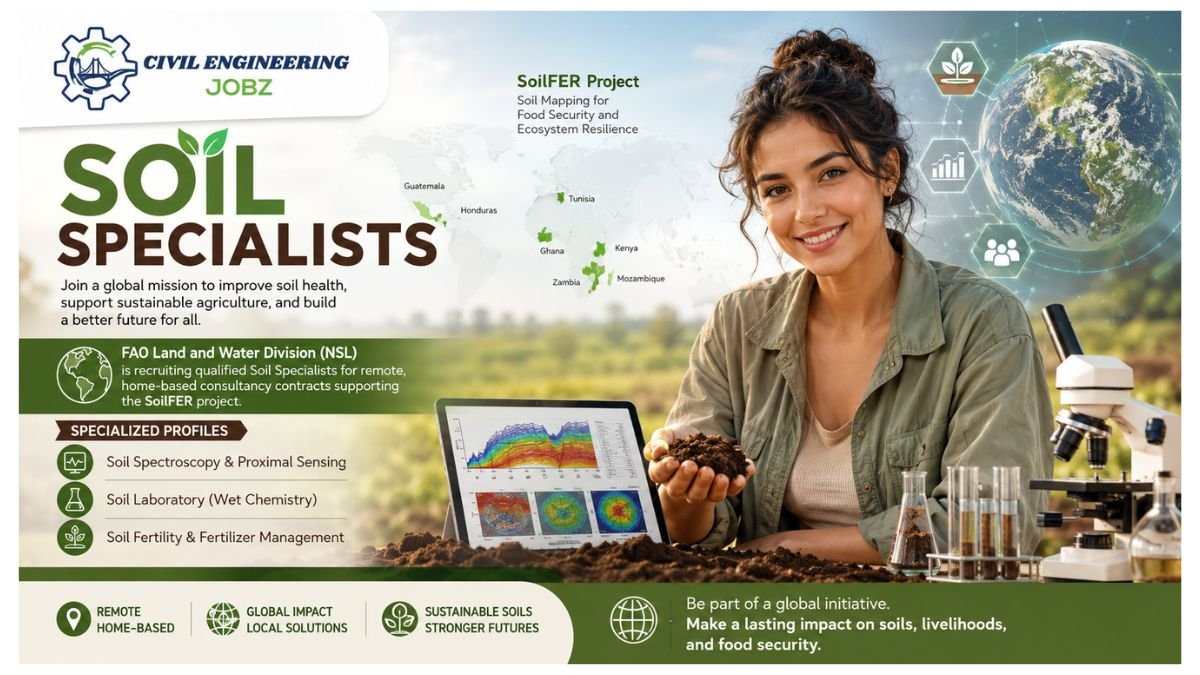
The FAO Land and Water Division (NSL) is recruiting qualified Soil Specialists for remote, home-based consultancy contracts supporting the SoilFER project — a landmark soil mapping initiative across 7 countries including Ghana, Kenya, Guatemala, Honduras, Mozambique, Tunisia, and Zambia. Three specialized profiles are open: Soil Spectroscopy & Proximal Sensing, Soil Laboratory (Wet Chemistry), and Soil Fertility & Fertilizer Management — all working to guide national policymaking and field-level fertilizer recommendations worldwide.
About FAO Land & Water Division — Global Soil Leadership
Mission: Enhance agricultural productivity and sustainable use of land, soil, and water resources globally
Project: SoilFER — Soil Mapping for Resilient Agrifood Systems in Central America & sub-Saharan Africa
Countries: Ghana, Guatemala, Honduras, Kenya, Mozambique, Tunisia, and Zambia
Networks: Global Soil Laboratory Network (GLOSOLAN) and GLOSOLAN-Spec initiatives
Impact: National soil policies, farmer tools, fertilizer recommendations at field and country scale
Why Join FAO as a Soil Specialist?
Remote Flexibility: Home-based contracts with field missions only when required
Global Impact: Shape national soil policy and food security for millions of smallholder farmers
UN Career Exposure: Work directly within FAO’s technical divisions and international project frameworks
Multi-Country Reach: Contribute expertise across 7 beneficiary countries spanning Africa, MENA, and Latin America
Position Overview
FAO’s Land and Water Division is building a qualified roster of Soil Specialists across three technical profiles to support the SoilFER project and related soil initiatives in seven beneficiary countries. These are home-based consultancy positions that combine remote technical work with periodic field missions. Specialists will report directly to the Land and Water Officer and provide high-level expertise in soil spectroscopy, laboratory management, or soil fertility — contributing to sustainable agriculture, climate resilience, and food system transformation at national and local levels.
Why This Role Matters: As an FAO Soil Specialist, you directly influence national soil policy across developing countries, support farmers with data-driven fertilizer tools, strengthen laboratory systems in underserved regions, contribute to climate change adaptation through sustainable soil management, and build a lasting UN career portfolio with international recognition across multiple countries and ecosystems.
Key Responsibilities by Specialization
Soil Spectroscopy & Proximal Sensing Specialist
- Support implementation of GLOSOLAN-Spec — FAO’s global soil spectroscopy network initiative
- Develop calibration models using existing Vis-NIR-MIR soil spectral libraries for estimating soil properties
- Deliver soil spectroscopy and proximal sensing capacity development programmes, including training sessions and material development
- Provide technical guidance on spectral data analysis and integration with national soil mapping systems
Soil Laboratory Specialist
- Oversee processing of soil samples for both wet and dry chemistry analysis across project countries
- Develop and implement quality assurance and quality control (QA/QC) measures and Standard Operating Procedures (SOPs)
- Support establishment and improvement of national soil laboratories and Laboratory Information Management Systems (LIMS)
- Collaborate with project partners to ensure accurate, timely soil analysis results and harmonized data outputs
- Support laboratory equipment procurement activities and participate in capacity-building workshops and training
- Contribute to progress reporting on soil analysis and harmonization for stakeholders and funding agencies
Soil Fertility & Fertilizer Management Specialist
- Identify and promote locally adapted soil management practices including fertilizer use efficiency and formula fertilization
- Support establishment of field trials to test and validate prioritized soil management practices and fertilizer recommendations
- Contribute to national decision support systems incorporating soil fertility and management data
- Assist in developing mobile and desktop farmer applications for sustainable soil management at farm scale
- Support national capacities for fertilizer analysis, alternative nutrient sources, and fertilizer use policy development
- Collaborate with extension services, farmer organizations, and educational institutions at local level
Qualifications & Requirements
Educational Requirements
- Master’s degree in Soil Science, Agriculture, Environmental Sciences, or a related field (recognized by IAU/UNESCO)
- Bachelor’s degree plus 2 years of relevant experience may be considered in certain circumstances
- PSA applicants: University degree in soil science or related field with relevant technical specialization
Experience Requirements
- Category C: 1–4 years of relevant experience in sustainable soil management, soil fertility, or laboratory analysis
- Category B: 5–9 years of relevant technical experience
- Category A: At least 10 years of relevant senior-level experience
- Field experience in developing countries, particularly in Africa or Latin America, is highly desirable
Essential Skills
- Working knowledge (Level C) of at least one FAO official language — English, French, Spanish, Arabic, Chinese, or Russian
- Demonstrated experience working with Member countries on normative and technical soil-related work
- Strong ability to deliver results within project deadlines and manage multiple technical workstreams
- Experience in preparing technical and policy reports, capacity development materials, and training content
- Familiarity with FAO policies, UN agendas, and Healthy Soils Facility frameworks is a strong asset
About FAO Land and Water Division
The FAO Land and Water Division works globally to enhance agricultural productivity and advance the sustainable use of land, soil, and water resources. Through technical assistance, policy guidance, and capacity development, FAO supports Member nations in adopting best practices in irrigation, drainage, soil conservation, drought mitigation, and water governance. The SoilFER project represents a flagship initiative combining soil data, digital tools, and national capacity building to create resilient and productive agrifood systems across Central America and sub-Saharan Africa.
FAO Core Values: Results Focus, Teamwork, Communication, Building Effective Relationships, Knowledge Sharing and Continuous Improvement.
Who Should Apply?
- Soil Scientists: With 1+ years of field or laboratory experience seeking impactful UN consultancy work
- Laboratory Specialists: Experienced in wet chemistry, QA/QC, Apply now for Soil Specialist jobs with FAO — remote work, home-based contracts, soil spectroscopy, soil laboratory, soil fertility. Master’s degree. 1–10+ years experience. UN careers open today!, and LIMS implementation
- Spectroscopy Experts: With Vis-NIR-MIR spectral library and calibration model development experience
- Soil Fertility Consultants: Skilled in fertilizer recommendations, field trials, and farmer advisory tools

Recently opened JOBS 👇
Agriculture Project Manager Jobs Ohio 2026
Plant Technologist Jobs Boston MA USA 2026
Soil Scientist Jobs UK 2025
Golden Harvest Agronomist Jobs Indiana 2026