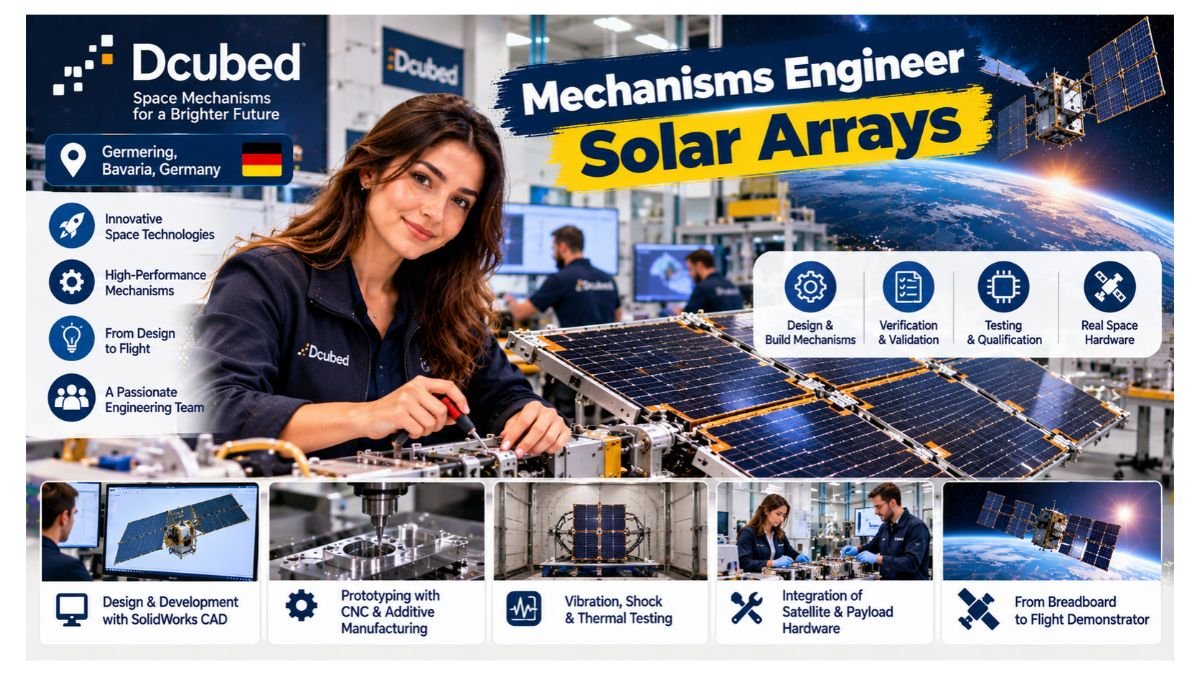
Dcubed, a pioneering space mechanisms company based in Germering, Bavaria (Munich Metropolitan Area), is hiring a Mechanisms Engineer – Solar Arrays to own the hands-on hardware verification and validation lifecycle for solar array mechanisms — from breadboard through engineering model to flight demonstrator. You will design and build Ground Support Equipment (GSE), define and execute rigorous qualification and test campaigns including vibration, shock, deployment, and thermal testing, integrate satellite and payload hardware, drive rapid prototyping cycles using SolidWorks CAD, CNC machining, additive manufacturing, and other advanced fabrication techniques, and support the AIT team through every phase of the space hardware development lifecycle. This is an outstanding opportunity for a hands-on aerospace or mechanical engineer in Germany who wants to work on real space hardware for solar array mechanisms at one of Europe’s most technically ambitious new-space companies — building the deployable structures that power satellites in orbit, in a high-velocity team that values engineering depth, practical ingenuity, and the relentless drive to build, test, learn, and improve.
About This Mechanisms Engineer – Solar Arrays Opportunity — Dcubed, Germering Bavaria Germany
Employer: Dcubed — a Germering-based new-space company specializing in deployable mechanisms and solar array systems for small satellites and spacecraft, operating at the frontier of the European and global commercial space sector, with a hands-on engineering culture built around rapid hardware development cycles, genuine technical ambition, and the practical engineering capability to take space mechanisms from concept to qualification to flight in compressed timelines that would be impossible for traditional aerospace primes — building the mechanisms that deploy solar arrays, antennas, and structures on the satellites that power the new space economy
Role Focus: End-to-end AIT and test infrastructure ownership for solar array mechanisms — defining and executing Assembly, Integration, and Test (AIT) activities across the hardware lifecycle from breadboard to flight demonstrator; designing, developing, and maintaining Ground Support Equipment (GSE) that enables safe and efficient hardware integration and testing; building and testing prototypes, breadboards, and engineering models using SolidWorks CAD and a full range of fabrication techniques; defining and executing qualification and verification campaigns including vibration, shock, deployment, and thermal testing; and supporting rapid prototyping cycles and continuous improvement of engineering methodologies with the hands-on mentality and technical ownership mindset that Dcubed’s fast-moving hardware development culture demands
Technical Depth: A genuinely hardware-intensive role at the intersection of mechanical design, space mechanisms, AIT engineering, and manufacturing — requiring proficiency in SolidWorks CAD design, GSE development, qualification campaign execution across multiple test disciplines (vibration, shock, thermal, deployment), hands-on fabrication using additive manufacturing, CNC machining, milling, turning, and laser cutting, and the structural analysis and mechanical systems development experience that bridges the gap between design intent and verified, flight-ready hardware performance
Location: Germering, Bavaria, Germany — located in the Munich Metropolitan Area, one of Germany’s most vibrant and technically excellent aerospace, robotics, and advanced engineering clusters, home to Airbus Defence & Space, ESA’s European Space Operations Centre (ESOC) regional partners, MTU, MAN, and a dense ecosystem of aerospace and deep-tech companies that create an unmatched environment for space and aerospace engineers seeking both technical excellence and the quality of life that Bavaria’s combination of world-class urban infrastructure and extraordinary natural environment uniquely provides
Why This Mechanisms Engineer – Solar Arrays Role at Dcubed Stands Out
Real Flight Hardware — Solar Arrays That Power Satellites in Orbit: There is a fundamental difference between aerospace engineering roles where the hardware you work on will fly in space and aerospace engineering roles where it will not. At Dcubed, the solar array mechanisms that the AIT and Test Infrastructure Engineer integrates, tests, and qualifies are real flight hardware — mechanisms that will deploy the solar panels that power real satellites in real orbits, generating the electrical power that enables every function of the spacecraft they are attached to. The technical seriousness of that responsibility — where a mechanism that fails to deploy correctly in orbit cannot be retrieved, adjusted, or repaired — is precisely what makes the AIT and qualification discipline of this role so technically demanding, professionally significant, and personally rewarding for engineers who are genuinely motivated by the challenge of building hardware that works perfectly the first time, in the most unforgiving environment that engineering hardware ever encounters.
Breadboard to Flight Demonstrator — Full Hardware Lifecycle Ownership at Speed: Many aerospace engineering roles at large primes involve narrow slices of the hardware lifecycle — a structural analysis team that never touches the hardware, an integration team that never designed any of it, a test team that never built the GSE it uses. At Dcubed, the AIT and Test Infrastructure Engineer owns the hardware lifecycle from breadboard through engineering model to flight demonstrator — designing the CAD models, building the prototypes, designing the GSE, executing the qualification campaigns, and iterating based on test results with the rapid learning cycles that new-space companies uniquely enable. That full-lifecycle ownership is the fastest and most effective way to develop the complete mechanical and AIT engineering depth that distinguishes exceptional space hardware engineers from specialists limited to one phase of the development process.
Dcubed’s New-Space Culture — Engineering Velocity, Hands-On Ownership, Technical Ambition: Dcubed operates with the engineering velocity of a well-funded new-space startup — where individual engineers have genuine ownership of their technical domains, decisions are made quickly on the basis of engineering evidence rather than organizational hierarchy, and the pace of hardware development cycles creates learning opportunities in months that traditional space primes might take years to provide. For an aerospace or mechanical engineer who is motivated by hands-on hardware work, technical ownership, and the satisfaction of seeing their engineering decisions validated by hardware that performs to specification under qualification-level loads and environments, Dcubed’s culture is a genuinely rare and exceptional engineering environment.
Germering — Bavaria’s Munich-Area Aerospace & Deep-Tech Hub: Germering’s location in the Munich Metropolitan Area places Dcubed engineers at the center of Germany’s most concentrated aerospace and deep-tech cluster — adjacent to the Airbus Defence & Space campus in Ottobrunn/Taufkirchen, the German Aerospace Center (DLR) in Oberpfaffenhofen, the Technical University of Munich’s aerospace engineering program, and the growing Munich new-space ecosystem that has emerged around companies including Isar Aerospace, Mynaric, OHB System, and others — creating an environment of technical peer quality, professional networking depth, and career optionality that no other location in Germany can match for a space mechanisms engineer.
Position Overview
This Mechanisms Engineer – Solar Arrays (AIT & Test Infrastructure) at Dcubed in Germering owns the practical execution of hardware verification and validation activities for solar array mechanisms across the complete development lifecycle — from breadboard through engineering model to flight demonstrator. The engineer develops test setups and procedures, integrates satellite and payload hardware, designs and builds Ground Support Equipment (GSE), executes vibration, shock, deployment, and thermal qualification and verification campaigns, drives rapid prototyping and continuous improvement cycles using SolidWorks CAD, additive manufacturing, CNC machining, and a full suite of precision fabrication techniques, and supports the AIT team with the hands-on technical ownership, practical problem-solving capability, and engineering rigor that flight-qualified space hardware demands at every phase of development.
Why This Role Matters: Solar arrays are the power source of every satellite — the single most critical mechanism on a spacecraft after the launch vehicle separates. A solar array that fails to deploy correctly in orbit does not just degrade satellite performance; it ends the mission. The mechanisms that deploy solar panels from their stowed launch configuration to their operational position — the hinges, deployment springs, hold-down and release mechanisms, and deployment actuators that Dcubed designs and builds — must work reliably in the thermal and vacuum environment of space after surviving the mechanical violence of launch: the vibration loads, shock events, and acoustic pressures of a rocket ascent that would destroy poorly designed or inadequately qualified mechanisms. The AIT and Test Infrastructure Engineer who defines the test campaigns that validate these mechanisms against flight environments, designs the GSE that enables safe and accurate hardware integration and testing, builds the breadboards and engineering models that reveal design weaknesses before they become flight hardware failures, and executes the qualification campaigns that prove flight readiness — is performing the engineering work that determines whether satellites make it to operational orbit or become expensive orbital debris. That is the professional weight, technical seriousness, and daily engineering significance of excellent AIT and test infrastructure work on solar array mechanisms at Dcubed.
Key Responsibilities
Assembly, Integration & Hardware Testing — Solar Array Mechanisms, Satellite & Payload AIT
- Actively collaborate with the engineering team in defining the satellite and/or payload integration approach for solar array mechanisms — contributing the AIT and test infrastructure perspective to integration approach decisions from the earliest design phases, identifying testability, accessibility, and GSE requirements that must be designed into the hardware before they become costly integration-phase constraints, and developing the integration approach documentation — integration procedures, cleanliness requirements, torque and fastener specifications, handling instructions, interface control requirements — that enables safe, precise, and repeatable hardware integration across the breadboard, engineering model, and flight demonstrator lifecycle stages
- Implement satellite and/or payload integration procedures for solar array mechanism hardware — executing the assembly and integration steps that build up solar array mechanism assemblies from component level through subassembly to full mechanism level with the precision, cleanliness discipline, and documentation rigor that flight-quality space hardware requires; managing the integration configuration records, as-built documentation, and non-conformance records that maintain hardware traceability through the full build and test lifecycle; and applying the hands-on assembly skill and practical hardware intuition that distinguishes engineers who truly understand how their designs go together in reality from engineers who understand only how they go together in CAD
- Execute hardware test campaigns spanning the full development lifecycle — building and testing breadboard hardware that explores mechanism concept feasibility and identifies design weaknesses at the earliest, lowest-cost point in the development cycle; transitioning validated concepts to engineering models that demonstrate full mechanical performance and structural integrity under qualification-level environments; and supporting the flight demonstrator build and test phases that confirm the hardware is ready for flight qualification with the measurement systems, data acquisition configurations, and test execution discipline that produces the test data records that verify flight readiness to the satisfaction of both the internal engineering team and external qualification review authorities
GSE Design, Development & Test Infrastructure — Vibration, Shock, Thermal & Deployment Campaigns
- Design, develop, and maintain Ground Support Equipment (GSE) for solar array mechanism integration and testing — engineering the mechanical fixtures, handling tools, alignment aids, deployment test rigs, electrical ground support equipment, and environmental test interfaces that enable safe, accurate, and repeatable hardware handling, integration, and test execution; applying SolidWorks CAD to GSE design with the same mechanical design rigor applied to flight hardware design — analyzing GSE structural margins under handling and test loads, designing for the cleanliness, electrostatic discharge (ESD), and contamination control requirements of sensitive space hardware, and manufacturing GSE using the full range of available fabrication techniques with the cost-efficiency and schedule-awareness that development-phase GSE budgets demand
- Define and execute development and qualification test campaigns across the full spectrum of mechanical and environmental test disciplines relevant to solar array mechanisms — including sinusoidal and random vibration testing at levels representative of launch vehicle environments, shock testing for separation and deployment events, deployment testing that validates mechanism deployment kinematics, deployment force margins, and deployment repeatability under ambient, thermal vacuum, and gravity-offload conditions, and thermal testing that validates mechanism performance across the full operational temperature range of the satellite’s orbital environment; developing test plans, test procedures, and acceptance criteria for each campaign; managing test facility interfaces; executing test campaigns with the measurement system expertise and real-time data evaluation capability that enables in-test decisions rather than post-test discoveries of inadequate data coverage
- Support rapid prototyping, hands-on experimentation, and continuous improvement of solar array mechanism products and engineering methodologies — fabricating prototype components and mechanism assemblies using additive manufacturing (FDM, SLA, SLS as appropriate for the prototype’s functional requirements), CNC machining, milling, turning, and laser cutting with the manufacturing process selection judgment that balances functional performance requirements against fabrication cost and lead time; designing and executing the quick-turn experimental tests that answer specific mechanism design questions at breadboard level before committing to the tooling and material costs of engineering model hardware; and documenting lessons learned, design improvements, and methodology refinements that incorporate prototype and test learning into the next development cycle with the speed and rigor that Dcubed’s rapid development tempo demands
Verification, Validation & Engineering Support — Structural Analysis, Documentation & Team Collaboration
- Support verification and validation activities across the solar array mechanism development program — contributing to verification matrix development that maps each mechanism requirement to the specific analysis, inspection, demonstration, or test activity that verifies its satisfaction; supporting structural analysis activities with test-derived data that validates finite element models and identifies the correlation adjustments required to make analytical predictions reliable; writing test reports that document test configurations, measurement data, result interpretation, and disposition of any anomalies or non-conformances with the technical clarity and completeness that makes test reports useful engineering records rather than mere compliance artifacts; and contributing to the configuration and design reviews where verification evidence is presented to internal and external review boards
- Apply strong problem-solving skills to complex and ambiguous engineering challenges in solar array mechanism development and AIT — bringing the hands-on hardware intuition and systematic diagnostic methodology that distinguishes experienced space hardware engineers: the ability to look at anomalous test data and reason from first principles about the physical mechanism that could produce the observed behavior; the fabrication and assembly experience to recognize when a mechanism’s in-test behavior reflects a manufacturing or integration issue rather than a design deficiency; the measurement systems knowledge to distinguish real physical behavior from instrumentation artifact; and the intellectual tenacity to pursue the root cause of a hardware anomaly until the mechanism is understood well enough to be corrected rather than managed around
- Balance technical excellence with pragmatism and execution speed — operating effectively under the competing priorities of a fast-moving new-space hardware development program, where the pressure to maintain development schedule must be balanced against the non-negotiable requirement for the engineering rigor and documentation discipline that produces flight-qualified hardware; managing multiple concurrent technical activities (GSE fabrication, test campaign preparation, integration procedure development, prototype build) without losing the attention to detail that prevents the kind of avoidable errors — wrong torque values, missed inspection steps, undocumented configuration changes — that turn into expensive hardware anomalies and schedule delays in later development phases
Qualifications
Essential Requirements
- Bachelor’s or Master’s degree in Mechanical Engineering, Aerospace Engineering, or a closely related discipline — with the academic foundation in solid mechanics, structural analysis, mechanism kinematics, thermodynamics, and materials science that underpins the mechanical design, structural assessment, and test campaign planning work of this role; a Master’s degree with thesis work in space mechanisms, deployable structures, or aerospace hardware development is a particularly strong qualification for the solar array mechanism focus of this position
- 3+ years of hands-on experience in mechanical design, structural analysis, or space hardware development — specifically in roles where the hardware was designed, analyzed, built, and tested to qualification standards rather than roles limited to analysis or design review without physical hardware involvement; experience at a space prime, new-space company, aerospace component manufacturer, or defense hardware developer where the work involved real mechanical hardware development from concept through qualification is the experience background that most directly prepares a candidate for Dcubed’s AIT and test infrastructure engineering role
- Proven experience developing complex mechanical systems from concept through testing, qualification, and production — with the full-lifecycle mechanical engineering perspective that comes from having personally navigated the transitions from concept design through CAD modeling, analysis, prototype fabrication, prototype testing, design iteration based on test results, engineering model build, qualification campaign execution, and production release; specific experience with deployable mechanisms, space mechanisms, or solar array hardware is a significant advantage
- Strong expertise in SolidWorks CAD — demonstrated through production use of SolidWorks for complex 3D mechanical component and assembly design, with kinematic assembly modeling for mechanism deployment simulation, drawing package development to manufacturing standards, and the SolidWorks Simulation familiarity for basic structural assessment that complements dedicated FEA analysis tools; SolidWorks is the preferred CAD tool at Dcubed and proficiency is a hard requirement for the GSE design and mechanism modeling work of this role
- Experience designing and executing qualification and verification campaigns for aerospace or high-performance hardware — including test plan and procedure development, test facility interface management, measurement system specification, real-time test execution, data analysis, anomaly investigation, and test report writing to the documentation standards that aerospace qualification authorities require; specific experience with vibration, shock, thermal, or deployment testing is directly applicable to the solar array mechanism qualification campaigns of this role
- Hands-on experience with manufacturing and prototyping using additive manufacturing, CNC machining, milling, turning, and laser cutting — the physical making skills that allow an engineer to move from a SolidWorks model to a functional prototype efficiently, to make intelligent fabrication process selection decisions based on material, tolerance, and functional requirements, and to contribute productively to a workshop environment where engineers are expected to build as well as design
- Strong problem-solving skills and a hands-on mentality with genuine passion for building, testing, and improving hardware — the intrinsic motivation that sustains the engineering quality and attention to detail required for flight-qualified space hardware development when the work is hard, the schedule is compressed, and the easy path would be to cut corners that a rigorous engineer will not cut; combined with the ability to balance technical excellence with pragmatism and the execution speed that a new-space development pace requires
Why Germering — Bavaria’s New-Space & Aerospace Engineering Hub
Germering sits at the western edge of the Munich Metropolitan Area, embedded in the most technically concentrated aerospace and advanced engineering cluster in Germany. Within a 30-minute drive of Dcubed’s Germering facility lie the Airbus Defence & Space campus in Ottobrunn and Taufkirchen (one of the largest space system engineering facilities in Europe), the German Aerospace Center (DLR) campus in Oberpfaffenhofen (home to DLR’s Space Operations Center, Earth Observation Center, and Institute for Robotics and Mechatronics), the Technical University of Munich’s Garching research campus, and the rapidly growing Munich new-space cluster that includes Isar Aerospace, Mynaric, OHB System, and a constellation of deep-tech companies building everything from launch vehicles to optical communications terminals to satellite propulsion systems.
Bavaria’s quality of life for engineering professionals is consistently ranked among the highest in Germany and Europe — a combination of outstanding cultural infrastructure (opera, museums, music), Bavaria’s extraordinary natural environment (the Alps within 90 minutes, lakes, forests, cycling and hiking infrastructure of a quality found nowhere else in Germany), Munich’s vibrant and internationally oriented city culture, and the compensation levels that reflect both the density of world-class engineering employers and the genuine scarcity of the most in-demand technical talent. For a space and aerospace engineer who wants to build flight hardware that matters, in a technically excellent team, in a location that offers an exceptional quality of life alongside an exceptional engineering career — Dcubed in Germering, Bavaria is an exceptional choice.
Career Keywords: Solar Array Mechanisms, AIT Assembly Integration Test, GSE Ground Support Equipment Design, SolidWorks CAD, Vibration Testing, Shock Testing, Thermal Testing, Deployment Testing, Satellite Integration, Payload Integration, Additive Manufacturing, CNC Machining, Milling Turning Laser Cutting, Rapid Prototyping, Breadboard Engineering Model Flight Demonstrator, Structural Analysis, Space Hardware Qualification, Mechanisms Engineer, Aerospace Mechanical Engineer — Dcubed Germering Bavaria Germany 2026.
Who Should Apply?
- Mechanisms Engineers — Solar Arrays AIT Test Infrastructure Germering Bavaria Germany 2026: Aerospace or mechanical engineers with 3+ years of space hardware AIT, GSE design, and qualification campaign experience — ready to join Dcubed in Germering for a permanent role with end-to-end solar array mechanism hardware lifecycle ownership, SolidWorks CAD design, and vibration/shock/thermal test campaign execution in one of Europe’s most technically ambitious new-space companies
- AIT Engineers — Space Hardware SolidWorks GSE Bavaria Germany 2026: AIT and test infrastructure engineers with satellite or aerospace hardware integration, GSE design, and qualification test experience — who want to apply that hands-on hardware expertise to solar array deployable mechanisms at a Germering-based new-space company where individual engineers own real hardware outcomes from breadboard to flight demonstrator
- Aerospace Mechanical Engineers — Additive Manufacturing CNC Prototyping Munich Area 2026: Mechanical engineers with aerospace hardware design, fabrication (additive manufacturing, CNC machining, milling, turning), and qualification campaign experience — who want to combine their CAD design and physical fabrication skills in a role where both capabilities are applied daily to build and test the space mechanisms that power commercial satellites in orbit
- Structural Test Engineers — Vibration Shock Thermal Space Hardware Germering Germany 2026: Structural and environmental test engineers with vibration, shock, thermal, and deployment test campaign experience on aerospace or space hardware — who want to expand their test engineering scope to full AIT and GSE design ownership in a Germering new-space company with a hands-on engineering culture, real flight hardware programs, and the Munich-area location that provides unmatched aerospace career networking depth
- Mechanisms Engineer Solar Arrays Dcubed Germering Bavaria Germany 2026 — AIT GSE SolidWorks: Seeking a Mechanisms Engineer – Solar Arrays position at Dcubed in Germering, Bavaria, Germany — where solar array mechanisms, AIT and test infrastructure, GSE design and development, SolidWorks CAD, satellite and payload integration, vibration testing, shock testing, deployment testing, thermal testing, additive manufacturing, CNC machining, rapid prototyping, breadboard to flight demonstrator lifecycle ownership, structural analysis, qualification campaign execution, and a genuine new-space hands-on engineering culture combine in a permanent role in the heart of Bavaria’s Munich-area aerospace and deep-tech cluster, with a benefits package that includes Deutschlandticket, EGYM Wellpass, ETF pension, modern workshop equipment, hybrid work arrangements, and the professional development investment of a company that builds flight hardware for the satellites that power the new space economy.

Recently Opening Job👇