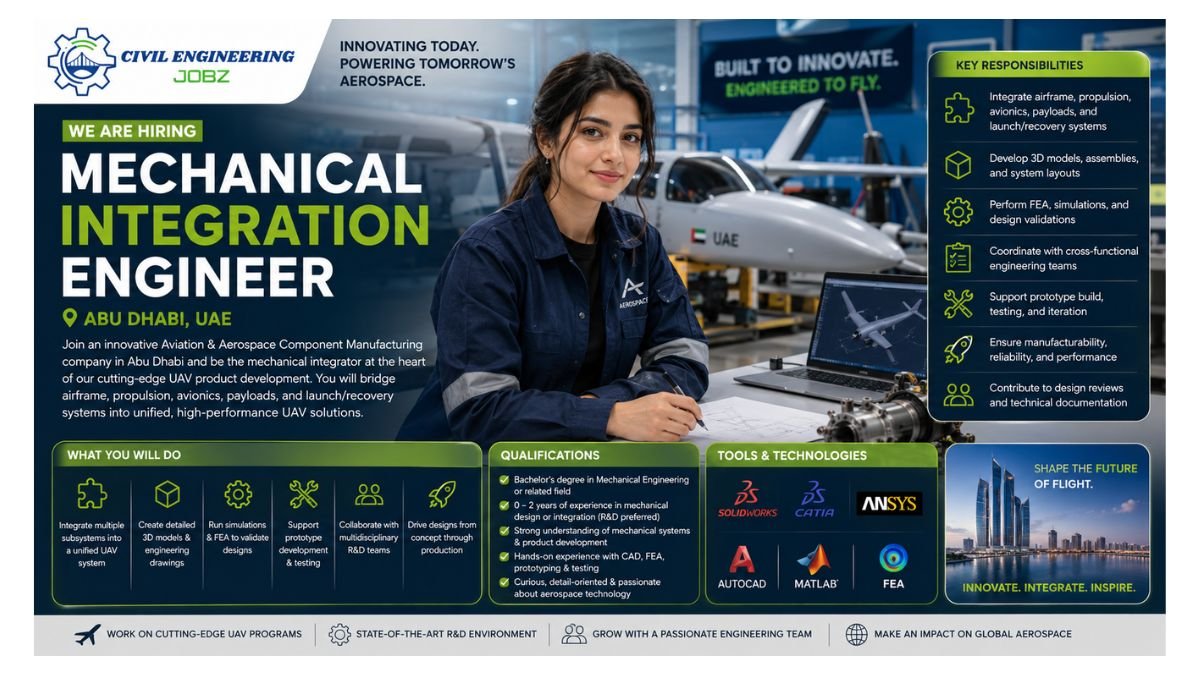
An innovative Aviation and Aerospace Component Manufacturing company in Abu Dhabi, UAE is seeking a curious, hands-on Mechanical Integration Engineer to join its cutting-edge R&D team. In this exciting early-career role, you will be at the core of the product development process — bridging multiple engineering disciplines to ensure that airframe, propulsion, avionics, payloads, and launch/recovery systems come together as a unified, functional UAV vehicle system. Working with tools including SolidWorks, CATIA, ANSYS, AutoCAD, MATLAB, and FEA, you will contribute from concept design through prototype build and serial production — making your work directly visible in every final product that takes flight.
About the Role — Mechanical Integration Engineer, UAV Aerospace R&D
Industry: Aviation and Aerospace Component Manufacturing — UAV (Unmanned Aerial Vehicle) product development in Abu Dhabi
R&D Scope: Concept design → prototype build → serial production — full product development lifecycle involvement
Systems Integration: Airframe, propulsion, avionics, payload, and launch/recovery subsystems into a unified vehicle design
Technical Tools: SolidWorks · CATIA · ANSYS · AutoCAD · MATLAB · FEA · PDM/PLM · GD&T / ASME/ISO drawing standards
Career Level: Early-career opportunity — 0–3 years experience · Fresh graduates and junior engineers encouraged to apply
Why This Mechanical Integration Engineer Role Stands Out
High-Impact Work: Your integration decisions are directly visible in the final UAV product — real engineering ownership from day one
Cutting-Edge Sector: Abu Dhabi’s aerospace and UAV industry is one of the UAE’s fastest-growing and most strategically invested technology sectors
Early-Career Growth: 0–3 years welcome — a rare chance to grow rapidly at the intersection of aerodynamics, structures, propulsion, and avionics
Cross-Disciplinary Exposure: Work directly with aerodynamics, structures, propulsion, avionics, manufacturing, and supply chain teams on live products
Position Overview
As Mechanical Integration Engineer in Abu Dhabi’s aerospace R&D sector, you will occupy one of the most technically rewarding and intellectually stimulating roles in UAV product development — responsible for ensuring that every subsystem, interface, cable route, mounting point, and mechanical connection within the vehicle works together as a coherent, manufacturable, and maintainable whole. From early concept studies and trade-off analyses through hands-on prototype assembly, manufacturing-ready drawing production, validation test planning, and design review presentations, your work will touch every stage of the UAV development process. This is a role for an engineer who genuinely loves understanding how complex systems fit together — and who wants to see the direct result of their engineering work take flight above Abu Dhabi’s skies.
Why This Role Matters: As Mechanical Integration Engineer, you are the connective tissue of the entire UAV product — the engineer who ensures that what the aerodynamics team designs can actually be built, that the avionics boxes fit within the airframe, that the cables are routed efficiently without interfering with structural members, and that the launch and recovery systems integrate seamlessly into a vehicle that performs exactly as intended in the field. In the UAE’s rapidly expanding autonomous systems and UAV manufacturing sector, mechanical integration engineers are among the most valuable and hardest-to-find technical professionals — and the work you do in Abu Dhabi today will shape the aerospace technology of tomorrow.
Key Responsibilities
Systems Integration — Airframe, Propulsion, Avionics & Payloads
- Participate in and support conceptual design studies — contributing to system-level architecture discussions and trade-off analyses that define the integration approach for each new UAV vehicle or variant
- Integrate airframe, propulsion, avionics, payload, and launch/recovery subsystems into a coherent, manufacturable, and maintainable vehicle design — taking full ownership of the integration master assembly
- Define mounting interfaces between mechanical and avionics systems — ensuring dimensional compatibility, vibration isolation, accessibility, and serviceability across the full vehicle architecture
- Own space allocation planning, cable routing strategies, and accessibility planning — designing for efficient in-service maintenance and clear access paths throughout the full UAV product lifecycle
- Proactively identify integration risks early in the design cycle — driving resolution through structured collaboration with subsystem owners before risks become expensive hardware changes
Prototype & Production Support — Assembly, Drawings & Manufacturability
- Support hands-on prototype assembly activities — providing real-time on-vehicle integration guidance to the build team and resolving fit/form issues practically and efficiently as they arise
- Produce clear, accurate, manufacturing-ready part and assembly drawings in SolidWorks — applying GD&T principles and ASME/ISO drawing standards to ensure drawings are unambiguous and build-ready
- Collaborate with manufacturing and supply chain teams to ensure designs are producible, cost-effective, and aligned with available manufacturing processes, materials, and supplier capabilities
- Apply Design for Manufacturability (DFM) and Design for Assembly (DFA) principles — continuously improving design solutions to reduce assembly time, part count, and production cost
Validation, Testing & Technical Documentation
- Develop validation and test plans to verify that integrated assemblies meet all defined design requirements — covering fit, function, structural integrity, and interface compatibility across all subsystems
- Support physical testing activities — recording detailed observations, collecting test data, and analyzing results against acceptance criteria to confirm or challenge design assumptions
- Author thorough, well-structured technical reports and presentations to support design reviews, project milestone gates, and engineering decision-making at team and management level
- Maintain accurate engineering documentation within PDM/PLM systems — ensuring all design data, drawing revisions, and integration decisions are properly controlled, accessible, and traceable
Qualifications & Requirements
Educational Requirements
- Bachelor’s degree or equivalent diploma in Mechanical Engineering, Aerospace Engineering, Industrial Engineering, Mechatronics Engineering, or a closely related technical discipline
- Strong academic foundation in mechanical design principles, engineering materials, manufacturing processes, and systems thinking — as demonstrated through coursework, projects, or internship experience
Experience Requirements
- 0–3 years of experience in a mechanical design, systems integration, or product development role — this is an early-career opportunity that welcomes recent graduates with strong fundamentals and genuine curiosity
- Demonstrated ability to work within multi-disciplinary teams and manage competing priorities — shown through academic projects, internships, capstone projects, or professional experience
- Exposure to aerospace, automotive, or complex electromechanical product development is a meaningful advantage — direct UAV experience is particularly relevant but not required
Technical Skills
- Strong proficiency in SolidWorks — particularly 3D modelling, assembly management, configurations, and drawing environments including GD&T annotation to ASME/ISO standards
- Familiarity with CATIA, AutoCAD, MATLAB, or additional CAD/engineering analysis tools — broader tool experience is valued in a multi-software R&D environment
- Basic to intermediate experience with FEA tools — SolidWorks Simulation, ANSYS, or equivalent — for structural analysis and design validation of mechanical components and assemblies
- Familiarity with PDM/PLM systems for engineering data management is a plus — understanding of revision control, BOM management, and change control workflows in a product development context
Bonus Skills — Nice to Have
- Knowledge of composite materials and manufacturing processes — including hand layup, resin infusion, bonding, co-cure, and inspection of composite structural parts
- Exposure to additive manufacturing technologies for prototyping or end-use part production — including material selection, design for AM, and post-processing considerations
- Familiarity with DFM and DFA principles — demonstrating an awareness of how design decisions impact manufacturing efficiency, assembly sequence, and production cost
- Basic understanding of aerospace certification or qualification requirements — design traceability, verification planning, and documentation standards relevant to certified aviation products
About the Employer — Abu Dhabi’s Aerospace & UAV Innovation Leader
This Mechanical Integration Engineer opportunity is with a forward-thinking aviation and aerospace component manufacturing company based in Abu Dhabi — a company that is actively developing and manufacturing next-generation Unmanned Aerial Vehicles (UAVs) for both commercial and specialized applications across the UAE and beyond. Operating at the forefront of the UAE’s rapidly expanding aerospace and autonomous systems sector, the company’s R&D team combines deep engineering expertise, a hands-on build culture, and a commitment to rigorous, evidence-based design practice that produces products of genuine quality and performance. Abu Dhabi’s strategic investment in aerospace technology, defence manufacturing, and advanced engineering makes it one of the most exciting locations in the world for early-career aerospace and mechanical engineers who want to work on products that genuinely push the boundaries of what UAV technology can achieve. Joining this team as a Mechanical Integration Engineer means contributing from day one to vehicles that you will see fly — right above the UAE’s skies.
Apply Now: If you are an inquisitive, technically capable, and hands-on engineer who wants to start your aerospace career at the heart of UAV product development in Abu Dhabi, this is the role for you. Apply today and help build the future of aviation from the ground up.
Who Should Apply?
- Aerospace & Mechanical Engineering Graduates: With 0–3 years of experience in mechanical design, product development, or systems integration — and a genuine passion for UAV or aerospace product engineering
- SolidWorks-Proficient Engineers: With strong 3D modelling, assembly management, and manufacturing drawing experience — and a desire to apply those skills in a fast-paced UAV aerospace R&D environment
- Systems Integration Enthusiasts: Who enjoy understanding how complex electromechanical systems fit together and thrive at the intersection of aerodynamics, structures, propulsion, and avionics
- Composite & Advanced Manufacturing Specialists: With composite material knowledge, additive manufacturing exposure, or DFM/DFA experience relevant to lightweight aerospace structures and UAV components
- Abu Dhabi-Based Engineering Graduates: Currently in or willing to relocate to Abu Dhabi — seeking an exciting early-career engineering role in the UAE’s growing aerospace and UAV manufacturing sector

Recently opened JOBS 👇🏻